People + Systems · Article
Apparently, I have a Type: Complicated Systems
What anthropology, sewing, Healthcare Administration, and Sterile Processing taught me about people, processes, and seeing how all the pieces fit together.
By Valerie Reed, CHL, CRCST, CIS, CER
rie//PROCESS · September 2026

Apparently, I have a type.
I started college as an anthropology major.
I love sewing.
I work in Sterile Processing.
These three facts appear to have been selected by a random-number generator.
Anthropology was the original plan—the wouldn't-it-be-amazing-if-I-could-actually-make-a-career-out-of-this plan. Eventually, practicality won. I switched to Healthcare Administration, moved on with my life, and assumed anthropology belonged to an earlier version of me.
Sewing became something I loved doing.
Healthcare became my field.
Sterile Processing became, somehow, where I built my career.
Three separate boxes.
Except, apparently, they aren't.
The more I thought about it, the more I realized that I may have been attracted to the same basic thing this entire time:
Complicated systems made up of interconnected pieces—and figuring out why they work, why they don't, and how all those pieces fit together.
Which means that anthropology pipedream may have followed me into Sterile Processing after all.
Honestly, that's mildly annoying information to discover this late.
What originally drew me to anthropology was people.
How we organize ourselves. How cultures develop. How rules and norms get created. How knowledge passes from one person to another. How groups collectively decide that this is just how we do things around here.
If you work in Sterile Processing, that last sentence should already be making you uncomfortable.
Because every SPD has a culture.
There are the formal rules: policies, procedures, standards, instructions for use, manufacturer recommendations, and documented workflows.
And then there are the actual rules.
The things people learn by watching the technician next to them. The shortcuts nobody remembers inventing. The unofficial workflow that somehow became official through sheer repetition. The tiny differences between shifts. The sacred traditions whose origins have been lost to time.
And, of course, the ancient SPD incantation:
"We've always done it this way."
Anthropology taught me to watch people.
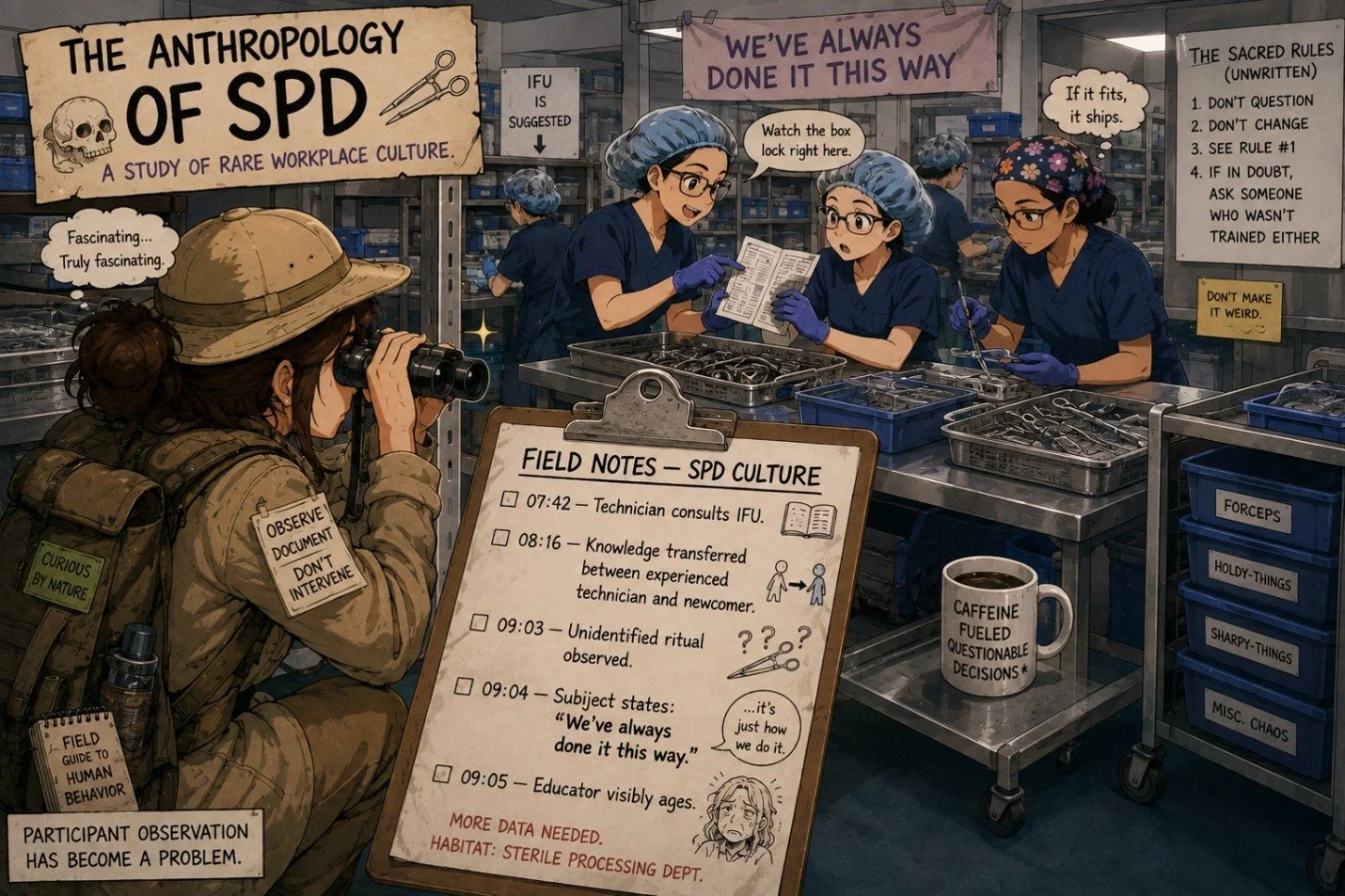
Anthropology looks at how knowledge, behaviors, and norms are transmitted through groups.
SPD educators spend an alarming amount of time discovering that this happens whether we want it to or not.
A new technician doesn't learn the job only from a competency document. They learn by watching experienced technicians. They listen to how people talk about the work. They notice which rules are treated as important and which ones are treated as optional. They figure out who people ask when they aren't sure about something. They learn what happens when someone makes a mistake.
They are not simply learning tasks.
They are learning the culture of Sterile Processing.
Suddenly, that abandoned major doesn't feel quite so unrelated.
This may also explain why I've become increasingly fascinated by the gap between education and actual practice.
Because humans are inconvenient little creatures.
We can tell someone what to do. We can give them a policy. We can hold an in-service. We can have them sign an attendance sheet. We can even validate that they can perform a task correctly while we're standing beside them with a clipboard.
And then Tuesday happens.
The department gets busy. Staffing gets tight. Something unusual comes through decontamination. A coworker shows them a "faster way." A process they've performed twenty times suddenly looks slightly different.
Now we find out what they actually learned.
That is why some of the most interesting questions in Sterile Processing education aren't: Did we teach it? or even: Can they demonstrate it?
They're:
What happens when nobody is watching?
What happens when conditions change?
What behavior has the department actually normalized?
Does the environment support the practice we're expecting?
And perhaps most importantly:
Why does this behavior make sense to the person doing it?
That last question is very anthropology-brained.
When a process repeatedly fails, it's tempting to assume someone simply needs more education.
Sometimes they do.
But sometimes the system itself is teaching something completely different from the PowerPoint.
“But I Told Them” Is Not a Behavior-Change Strategy
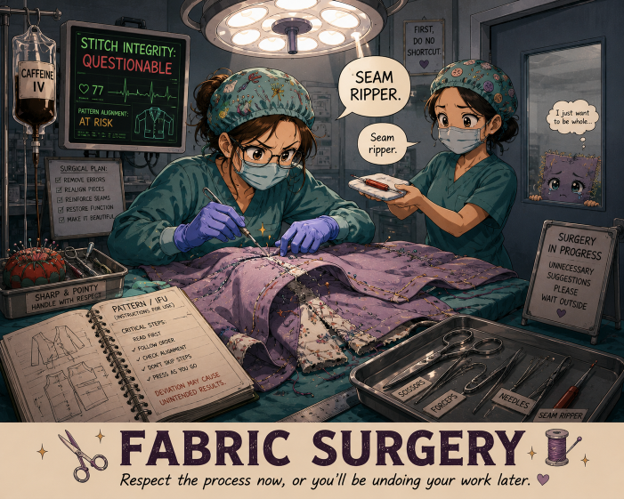
Meanwhile, Sewing Has Been Quietly Teaching Me SterilE Processing
Then there's sewing—or, as I have referred to it for years:
Fabric surgery.
In hindsight, perhaps I should have noticed the connection sooner.
Sewing involves taking a perfectly innocent piece of fabric, cutting it into alarming shapes, performing a series of highly specific interventions, occasionally removing stitches when something has gone terribly wrong, and ultimately hoping the patient emerges functional and looking approximately the way you intended.
There are instruments. There are sharp objects.
There are specialized tools whose purpose is obvious only to people within the profession.
There are instructions that become increasingly important immediately after you decide you don't need them.
And there is always the possibility of looking down at your work and quietly saying:
"...well, that's not supposed to be there."
Fabric surgery.
Apparently I have a brand.
At first glance, sewing and Sterile Processing still seem to have approximately nothing in common.
One involves fabric, thread, and an unreasonable emotional attachment to owning scraps that are "definitely big enough to use for something." The other involves medical devices, decontamination, sterilization, quality systems, and patient safety.
But the mental processes are surprisingly similar.
Sewing requires precision. Sequence matters. Orientation matters. Materials matter. Measurements matter. You have to understand how individual components interact. You have to inspect your work.
And you have to resist the dangerous little voice in your head that occasionally whispers: Eh. Close enough.
A sewing pattern essentially says: Follow these steps, in this order, using these materials and measurements, because seemingly minor changes may affect the finished product.
Congratulations.
You have discovered the IFU.
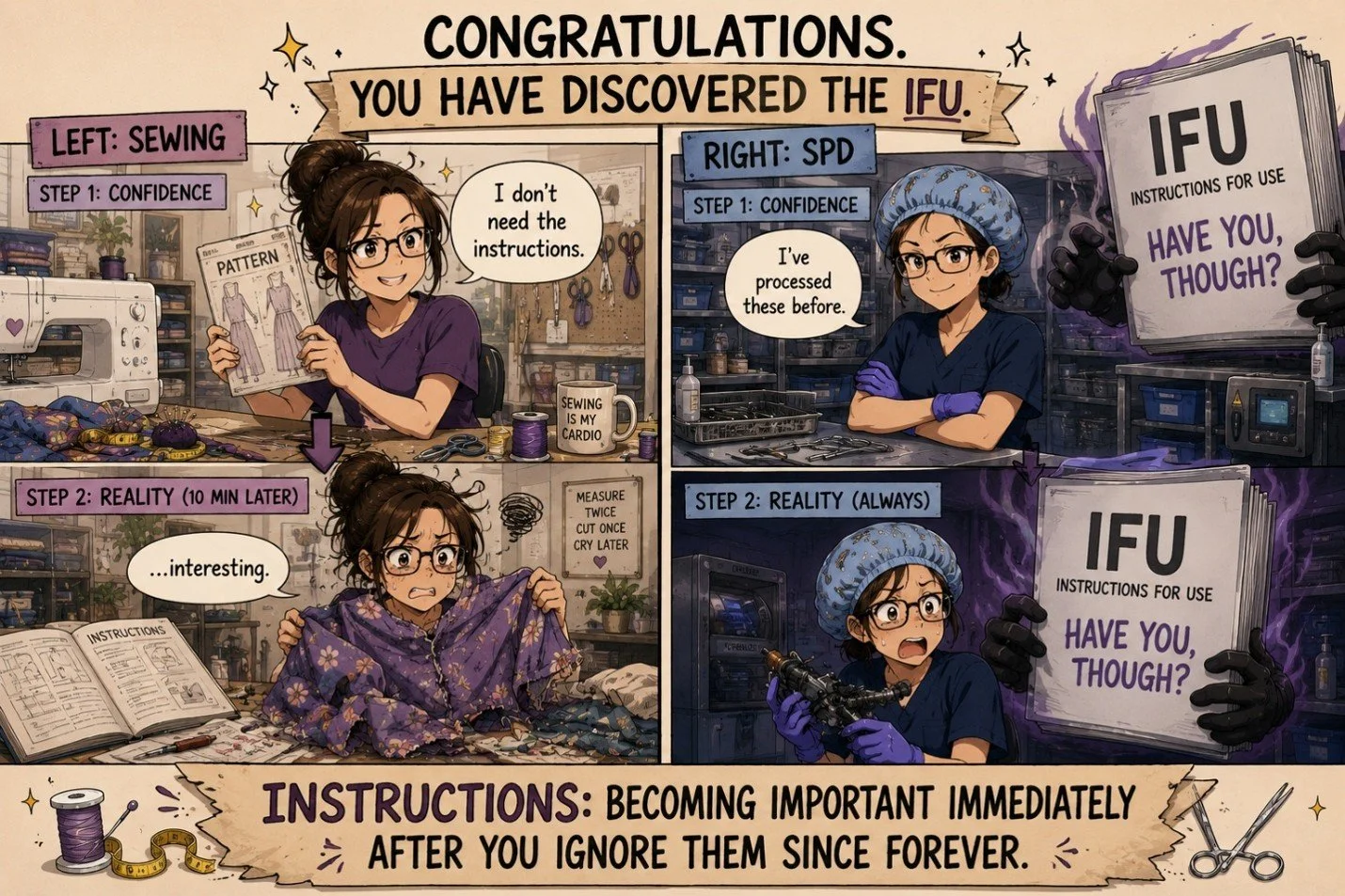
Anyone who sews also knows what happens when you decide the instructions are merely suggestions.
Sometimes you get away with it.
Sometimes you spend the next forty-five minutes staring at something you've sewn backward while reconsidering every decision that brought you to this moment.
Or reaching for the seam ripper. Again.
The seam ripper may actually be the most SPD-compatible object in my sewing room.
It exists almost entirely because humans make mistakes and sometimes the only responsible response is:
Nope. We're taking this apart and doing it correctly.
If that isn't reprocessing energy, I don't know what is.
Sterile Processing is considerably less forgiving of creative interpretation, but the lesson is remarkably similar:
Respect the process now, or you may be undoing your work later.
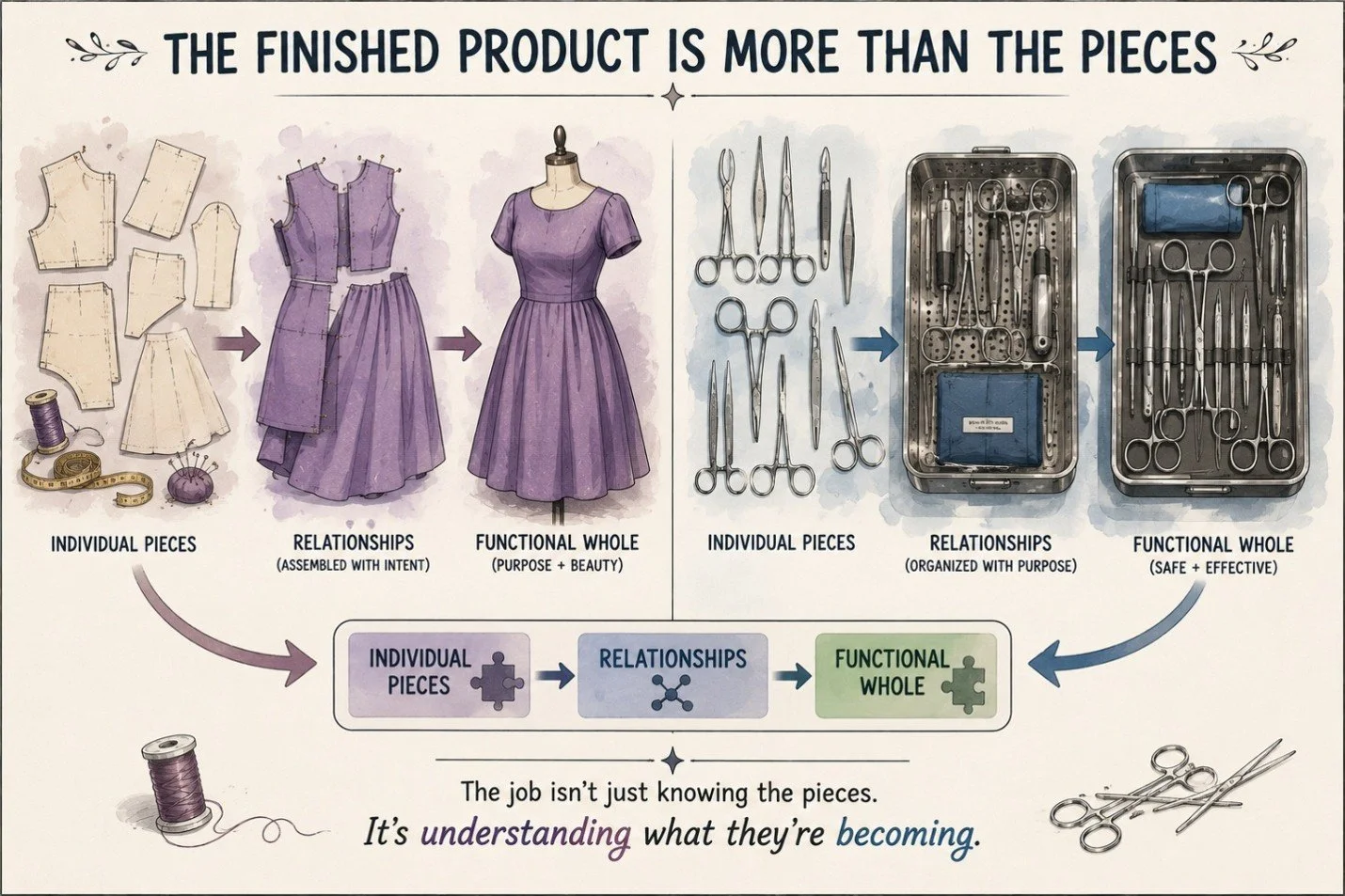
The connection goes deeper than following instructions. When I'm sewing, I don't really see individual pieces of fabric. I'm thinking about what they're becoming.
This piece attaches to that piece. This seam affects the way the next section fits. This zipper needs to be positioned correctly now because six steps from now I will deeply regret it if it isn't.
You're constantly moving between the individual component and the finished system.
Sterile Processing requires the same kind of thinking. A surgical set isn't simply a collection of instruments.
Each instrument has a purpose. Its condition matters. Its placement matters. Its relationship to the other devices matters. Missing one seemingly insignificant component can affect the usefulness of the entire set.
The technician assembling it has to see both things simultaneously: the instrument in their hand and the procedure this entire system must eventually support.
That's construction thinking. And apparently my brain really likes it.
The Finished Product Is More Than The Pieces
There's another similarity between sewing and SPD that I think matters even more.
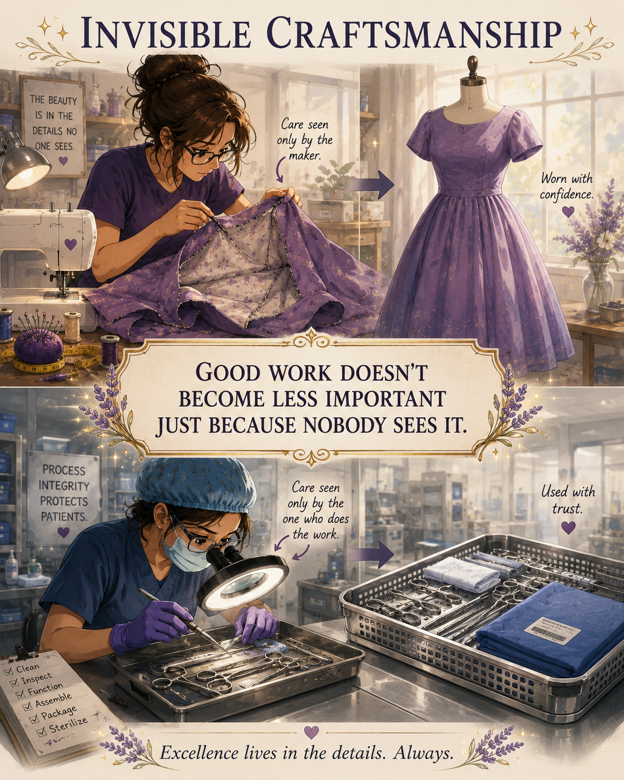
Some of the best work is invisible in the finished product.
Someone wearing something I made may never inspect the seam finish inside the garment.
They probably won't know that I reinforced a stress point, carefully matched something, ripped out a questionable seam, or redid an entire section because it wasn't quite right.
They just experience the result.
It fits.
It functions.
It holds together.
Sterile Processing is full of invisible craftsmanship.
The surgical team opening a tray doesn't see every step that happened before it reached them.
They don't see the technician who carefully inspected an instrument under magnification.
They don't see someone stop because something didn't look right.
They don't see the cleaning verification, the assembly decisions, the packaging inspection, the sterilization monitoring, the documentation, the troubleshooting, or the person who caught a problem and refused to send it forward.
When the work is done well, much of it disappears into the finished product.
The fact that nobody sees the work doesn't make the work less important.
Sometimes it means the work was done exactly as it should have been.
Quality Is Often Invisible
And perhaps that's part of the satisfaction in both.
There is a particular kind of pride in knowing that something is right even when the person receiving it will never know everything you did to make it right.
Apparently, I Like Systems.
And this is where anthropology, sewing, Healthcare Administration, and Sterile Processing finally collide.
Anthropology taught me to be curious about relationships within a human system. Sewing taught me to understand relationships within a physical system. Healthcare Administration added the organizational system: how people, resources, policies, processes, and competing priorities have to somehow function together.
Sterile Processing demands all three.
People.
Processes.
Equipment.
Medical devices.
Standards.
Education.
Communication.
Workflow.
Culture.
Quality.
None of them exist independently. Change one part and something else moves. A surgical set isn't a pile of instruments. An onboarding program isn't a pile of competencies. A department isn't a pile of employees. And a quality program isn't a pile of audits.
They're systems.
The relationships between the pieces are often just as important as the pieces themselves.
Maybe that's why I have such a difficult time looking at an isolated problem and leaving it isolated. If someone repeatedly performs a process incorrectly, I want to know what they were taught.
Then I want to know who taught them.
Then I want to know what the competency says.
Then I want to know what the policy says.
Then I want to know what the IFU says.
Then I want to know what everyone else is actually doing.
And approximately seventeen minutes later, I have accidentally launched an ethnographic investigation of the Prep & Pack department.
This explains more than I would like it to.
But this realization made me think about something bigger than my own strange collection of interests.
People enter Sterile Processing from everywhere.
Healthcare.
Food service.
Retail.
Manufacturing.
The military.
Automotive repair.
Hospitality.
Education.
Warehousing.
Or sometimes with no professional background remotely related to healthcare.
It can be easy to focus on everything a new technician doesn't know yet.
They don't know the instruments. They don't know sterilization. They don't know the terminology. They don't know the standards. They don't know our processes.
But they didn't walk through the door empty-handed.
The person from food service may already understand workflow, contamination control, urgency, and teamwork. Someone from retail may be exceptionally good at prioritizing competing demands while communicating with several people at once. Someone with a mechanical background may intuitively understand how devices move, articulate, connect, and fail. Someone who plays complicated video games may have spent years learning complex systems, recognizing patterns, managing resources, troubleshooting problems, and adapting when conditions change. Someone who crafts, builds, repairs, cooks, coaches, teaches, organizes, or creates has probably developed abilities that will surface somewhere in their Sterile Processing practice.
We spend a lot of time teaching people what they need to become Sterile Processing professionals.
Maybe we should also get better at asking: What did they bring with them? Because sometimes the seemingly unrelated pieces of someone's life turn out to be remarkably relevant.
And for educators and preceptors, knowing what someone already brings to the table can give us something to build on. The new technician may not know a Kelly from a Kocher yet. That's teachable. But they may already know how to troubleshoot. How to work with their hands. How to follow a complex sequence. How to notice small inconsistencies. How to remain functional while twelve things require their attention. How to ask why a group does something the way it does.
Those aren't irrelevant experiences.
They're foundations.
Nobody Arrives in SPD Empty-Handed
I used to think anthropology belonged to a path I didn't take. I started there because I loved it. Then reality intervened, Healthcare Administration made more practical sense, and I changed direction. Except maybe we don't leave those abandoned directions entirely behind.
The way we think doesn't reset when we change majors, careers, or interests. We carry things with us.
Old jobs.
Hobbies.
Classes we took.
Subjects we couldn't stop reading about.
Mistakes.
Interests.
Things we built.
Things we studied because we found them fascinating even when we weren't quite sure what we were going to do with them.
All of it quietly influences what we notice and how we solve problems. Anthropology taught me to look at the culture surrounding the process. Healthcare Administration taught me to look at the system supporting the process. Sewing taught me to respect the construction of the process. And Sterile Processing gave me somewhere to use all three.
So maybe anthropology wasn't simply the unrealistic pipedream I left behind. Maybe sewing isn't simply the weird thing I do at home with an alarming collection of sharp objects. Maybe the common thread has been there all along.
I like complicated systems.
I like figuring out how the pieces fit together.
I like understanding why something works.
And when it doesn't work, I apparently have a deep and possibly unhealthy need to figure out why.
Which, now that I think about it, is a reasonably accurate description of my entire career.
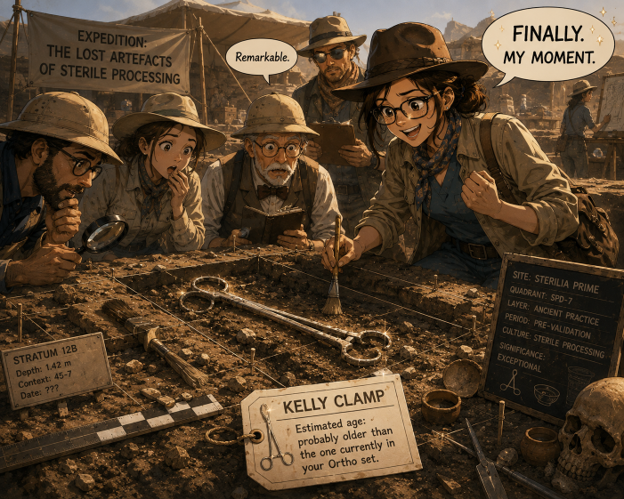
I'm still waiting for someone to ask me to carbon-date a Kelly clamp, though.
Then I'm really going to shine.
The Weird Stuff Comes With Us
Keep Exploring
If This Got You Thinking…
Related Article
See how systems thinking changes the way onboarding can be designed around both competency and readiness.
One Onboarding Program, Two Jobs
For Educators
Explore why demonstrated skill and readiness for independent practice aren't necessarily the same thing.
Competency vs. Readiness
Quick Learning
Tiny Tech Tips
Small lessons that turn individual SPD details into practical, memorable concepts.