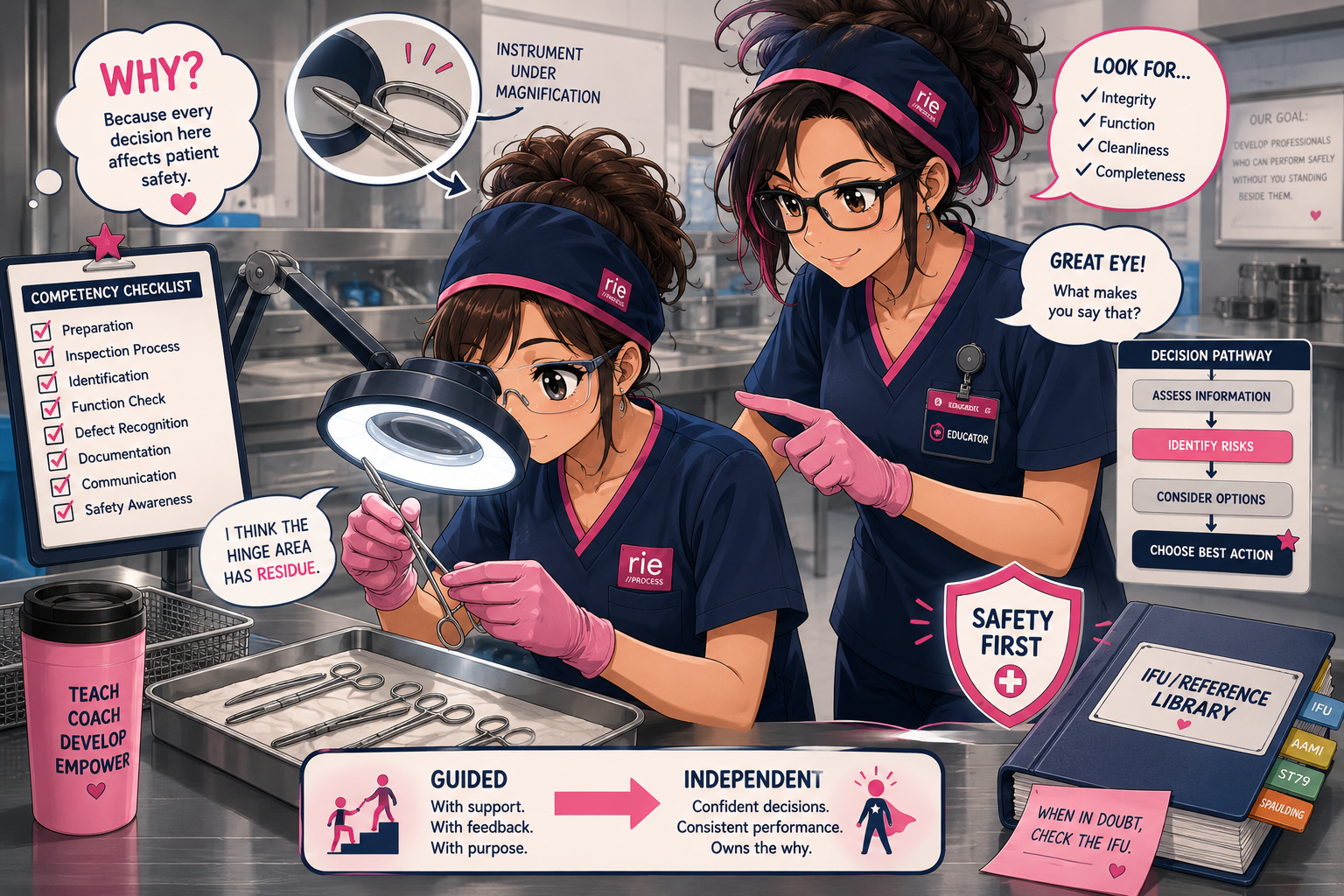
Teach the Work.
Develop the Professional.
For SPD Educators + Preceptors
Teaching sterile processing is more than showing someone the steps.
Explore practical tools and ideas for training, assessment, competency, coaching, and developing professionals who can eventually perform safely without you standing beside them.
EXPLORE EDUCATOR RESOURCES ↓
The Work Behind the Work
Sterile processing educators and preceptors are often asked to turn knowledge into performance - sometimes without much guidance about how to actually do that.
You’re expected to explain complex processes, develop new professionals, assess performance, give meaningful feedback, identify learning needs, document competency, support remediation, and determine when someone is ready for greater independence.
That requires a different set of skills.
Knowing How to do the job doesn’t automatically teach you how to teach it.
Teach
Make complex processes understandable.
Observe
Recognize what performance actually demonstrates.
Coach
Help learners improve without simply giving them the answer.
Validate
Determine whether learning has translated into safe performance.
Being good at sterile processing and being good at developing sterile processing professionals are two different skills.
Competency + Readiness
Completing Training isn’t the Finish Line.
Someone can complete orientation, demonstrate a task, and still need support before they’re ready to perform consistently and independently.
Effective educator systems distinguish between learning the work, demonstrating the work, and being ready to own the work.
Competency vs. Readiness
They’re related. They’re not interchangeable.
Competency asks whether someone can demonstrate the required knowledge and performance.
Readiness asks a bigger question: can they apply it consistently, make appropriate decisions, recognize when something is wrong, and work safely with increasing importance?
Competency Validation
A completed checklist documents an evaluation. It doesn’t automatically tell you whether the evaluation measured meaningful performance.
Explore how observable criteria, appropriate validation methods, evaluator consistency, and evidence of performance make competency validation more useful.
The form is not the competency.
Safety-Critical performance
Some mistakes matter more than others.
Not every performance criterion carries the same level of risk. Learn how identifying safety-critical behaviors can help educators distinguish between development opportunities and performance that requires immediate intervention.
The Form is Not the competency.
The performance is.
From Guided Practice to Independence
Competent Doesn’t Always Mean Ready.
Performing a task successfully during training is an important milestone. But readiness for independent practice requires more.
Educators and preceptors need to look for competency, judgment, prioritization, problem-solving, and the ability to recognize when something isn’t right - especially when no one is standing nearby with the answer.
The Readiness Progression
Learn
The learner develops foundational knowledge, observes the process, asks questions, and begins connecting individual tasks to their purpose.
Understand the work.
Practice
Perform with guidance.
The learner begins performing the work while a preceptor provides instruction, correction, feedback, and support.
Demonstrate
Show competent performance.
The learner demonstrates the required knowledge and skills against defined performance expectations.
Apply
Use it when the situation changes.
Support decreases. The learner begins prioritizing, troubleshooting, recognizing risk, and making appropriate decisions without waiting to be told what to do.
OWN
Perform safely with independence.
The professional demonstrates consistent performance, sound judgment, appropriate escalation, and accountability for the work.
Readiness Looks Like…
Consistency
Can they perform correctly more than once?
Judgment
Can they decide what to do when the answer isn’t immediately obvious?
Prioritization
Can they recognize what needs attention first?
Risk Recognition
Do they notice when something isn’t right?
Appropriate Escalation
Do they know when to stop, ask, verify, or seek help?
Independence doesn’t mean never asking for help. It means knowing when help is needed.
→ MORE INDEPENDENCE
MORE GUIDANCE ←
Precepting + COaching
Don’t Just Show Them How You Do it.
Effective precepting isn’t “watch me, then do what I did.”
Preceptors help learners understand the why, practice safely, recognize their own mistakes, make decisions, and gradually take greater ownership of the work.
The goal is to decrease support as capability grows - not create permanent dependence on the preceptor.
At First…
Then…
Next…
Eventually…
-
Demonstrate the process, explain your reasoning, connect actions to purpose, and make expectations clear.
-
Let the learner perform. Ask questions that reveal their thinking instead of immediately providing the answer.
-
Reinforce effective performance, identify gaps, and give specific feedback the learner can actually use.
-
Create space for the learner to prioritize, decide, problem solve, and recognize when they need help.
The Preceptor Shift
Ask Better Questions
Instead of:
“Do you understand?”
Try questions that reveal thinking:
“What are you looking for?”
“What would make you stop here?”
“How would you decide what to do next?”
“What information would you verify?”
More Direction
Give Useful Feedback
More Autonomy
Good feedback identifies the specific performance, explains why it matters, and makes the next expectation clear.
Not:
“Be more careful.”
But:
“Before placing the instrument in the tray, inspect the hinge under magnification. Residual soil can remain in areas that aren’t easily visible.”
Respond to Performance Gaps
A performance gap doesn’t automatically mean someone needs to repeat the entire training process.
Identify what happened, determine the underlying learning need, provide targeted coaching or remediation, and then verify that performance has improved.
A good preceptor doesn’t create a better follower.
They develop someone who can think without them.
Education Design
Don’t Start With the PowerPoint.
Good education starts with a different question:
What should someone be able to understand, decide, or do when this learning is over?
Once that’s clear, the objectives, teaching method, practice activities, and assessment can all be designed around the outcome - not around filling an hour of classroom time.
01 - Define the Outcome
What should change because of this education?
Start with what learners should know, understand, recognize, decide, or perform - not with how many slides you need.
02 - Teach the Concept
Give learners what they need to understand.
Explain the information clearly, connect it to existing knowledge, and make the purpose behind the process visible.
03 - Practice the Application
Give them something to do with what they learned.
Use scenarios, decisions, demonstrations, activities, discussion, or guided practice to move beyond passive listening.
04 - Assess the Learning
Find out whether it worked.
Choose an assessment method that actually matches the objective - knowledge questions for knowledge, application for decision-making, and observation for performance.
OUTCOME → INSTRUCTION → APPLICATION → ASSESSMENT
If those four pieces don’t line up, the education probably won’t, either.
Learning Objectives
Write objectives that describe meaningful learner outcomes instead of vague educational intentions.
Teaching Methods
Choose the method based on what learners need to accomplish - not simply what’s easiest to deliver.
Learning Activities
Turn information into application with scenarios, problem-solving, discussion, practice, and other active-learning strategies.
Assessment
Match the assessment to what you actually intended learners to learn.
Adults bring experiences, habits, questions, pressures, and existing knowledge into the learning environment.
Make the learning relevant. Give it context. Let people participate. And show them why it matters.
Remember Who You’re Teaching
If You want people to Apply It,
Give them a chance to practice applying it.
Explore the Libary
Find what you need to teach the work.
Whether you’re developing a new technician, supporting preceptors, validating competency, or building staff education, explore practical rie//PROCESS resources designed for the people responsible for helping others learn SPD.
Competency + Readiness
Explore approaches to competency validation, readiness, performance criteria, progression, and determining when someone is prepared for greater independence.
Move beyond completed checklists.
Featured resources:
Precepting + Coaching
Develop the people developing your people.
Explore practical approaches to guided practice, questioning, feedback, coaching, remediation, and supporting learners as they become more independent.
Featured resources:
Education Design
Build learning around what people need to do.
Explore learning objectives, teaching strategies, active learning, assessment, and ways to make sterile processing education more applicable.
Featured resources:
Educator Tools
Sometimes you just need something useful.
Quick reference tools, discussion resources, templates, activities, and other practical materials for SPD educators and preceptors.
The educator library will continue to grow as new rie//PROCESS tools, guides, and learning resources are developed.
From rie//PROCESS
Articles for people who teach, coach + Build SPD Systems
Explore longer-form thinking on precepting, onboarding, competency, quality improvement, and developing stronger technicians.

Educator Resources
Sometimes you need the framework. Sometimes you need the idea.
And sometimes you need a resource that is already built so you can stop formatting a worksheet at 10:47 p.m. and go do literally anything else.
The rie//PROCESS Resource Shop includes ready-to-use and adaptable materials designed to support sterile processing education, assessment, and learner development.
You Don’t Have to Build Everything From Scratch.
Learning ACtivities
Interactive activities and challenges designed to move learners beyond passive review and into application.
EduCator + Facilitator Resources
Instructor materials, teaching guides, answer keys, prompts, and tools that make implementation easier.
Assessment + Development Tools
Resources designed to support knowledge assessment, competency, professional development, and certification readiness.
Sometimes You Don’t Need Another Template.
Need More Than A Resource?
A new checklist, worksheet, or competency form can be useful - but a resource can only solve a resource problem.
If the real challenge is inconsistent training, unclear expectations, disconnected competency processes, preceptor development, or an education system that has grown without much structure, another document probably isn’t the whole answer.
Sometimes the work isn’t creating a better form. It’s building a better system around it.
When Consulting May Make More Sense
Education + Training Systems
When onboarding, training, precepting, or ongoing education needs greater structure and consistency.
Competency + Readiness Systems
When you need to strengthen how performance is defined, validated, documented, and connected to readiness for independent practice.
Curriculum + Resource Development
When you have a specific educational need but need something custom-built for your learners, organization, or goals.
Not sure whether you need a resource or a bigger solution?
You don’t have to diagnose the education system before reaching out. Start with what isn’t working.