For Educators · Competency
Not every competency criterion carries the same level of risk.
When an action directly protects the employee, the process, or the patient, failure to perform it correctly may matter more than the overall score.
Safety-critical performance deserves safety-critical expectations.
Some Performance Can’t Be “Almost Right.”
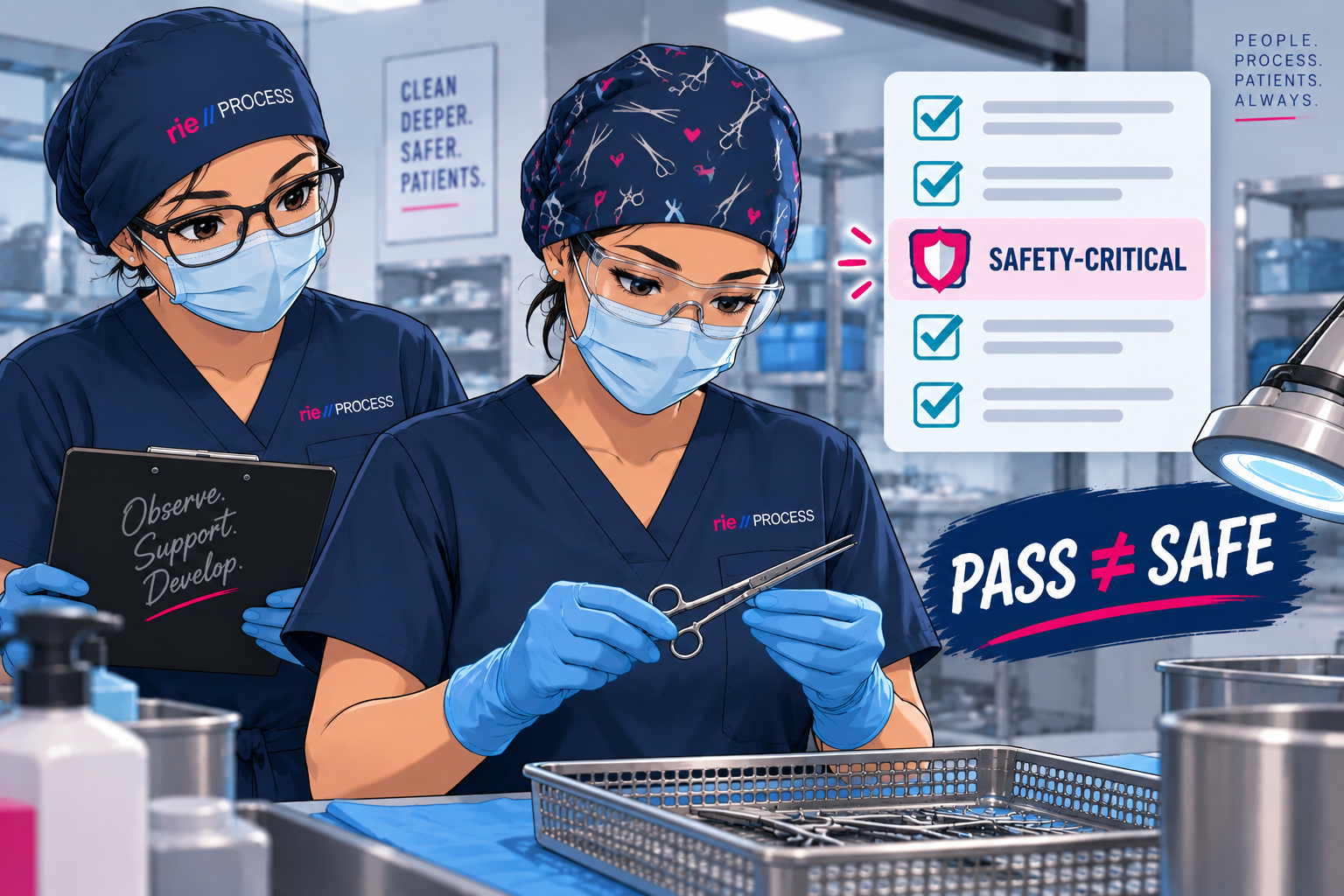
Competency Scoring
Imagine a competency with ten performance criteria.
One is performed incorrectly.
9 / 10 = 90%
That looks like a passing score.
But what if the missed criterion involved:
PPE?
DEVICE CLEANING?
CYCLE SELECTION?
STERILIZATION MONITORING?
PACKAGE INTEGRITY?
The number along doesn’t tell you whether the performance was safe.
A Passing Score Can Hide the Wrong Failure.
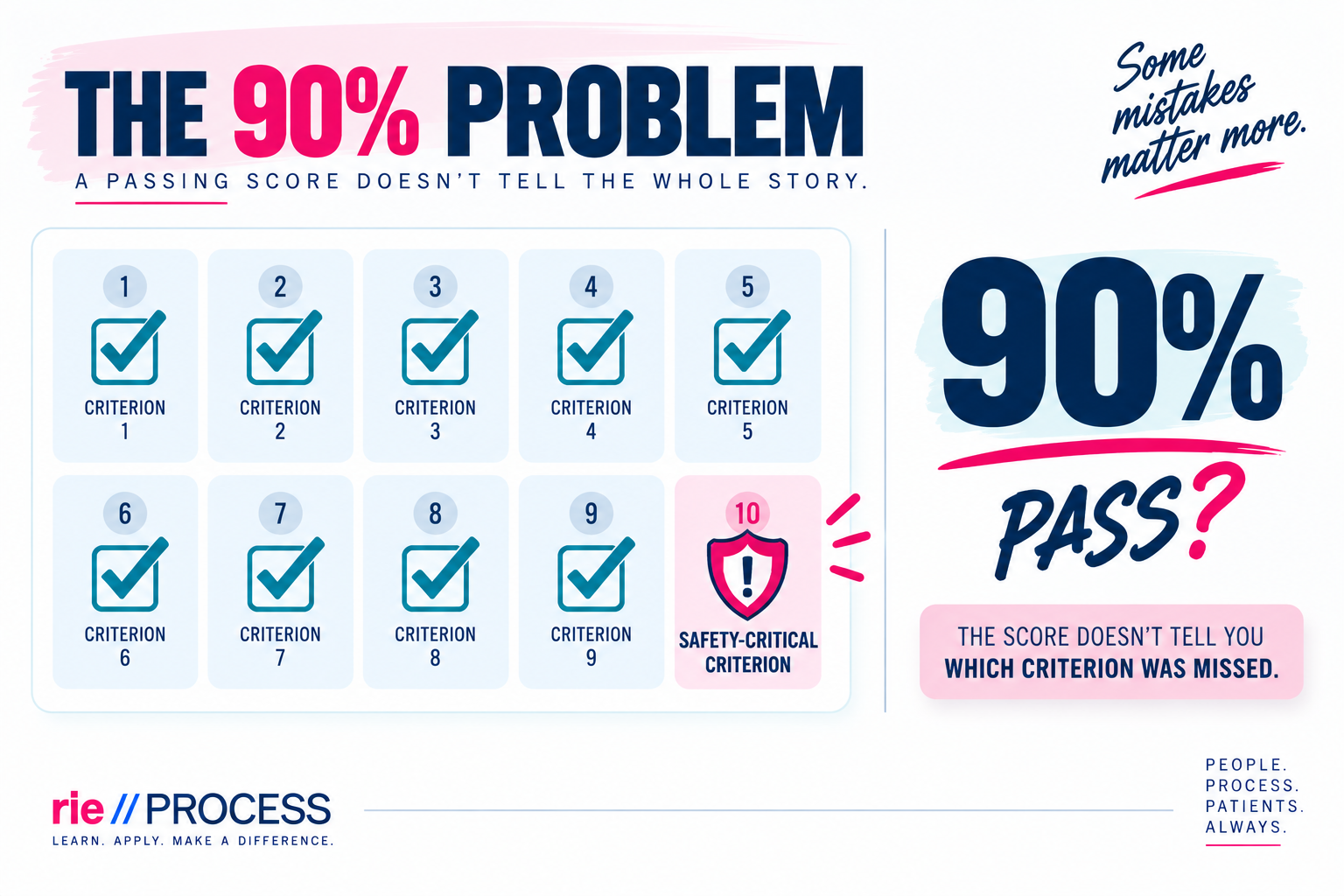
Total Score ≠ Whole Story
Safety-Critical Criteria
Start With the Consequence of getting It Wrong.
A criterion may deserve safety-critical status when incorrect performance could directly compromise:
-
A required step is missed or performed incorrectly in a way that could invalidate the process.
-
The device could remain contaminated, damaged, improperly prepared, or otherwise unsuitable for use.
-
The error could compromise the sterilization process or sterile barrier.
-
The performance creates a meaningful risk that could reach the patient.
The Label Should Reflect the Risk.
Not every important criterion needs to be designated as safety-critical.
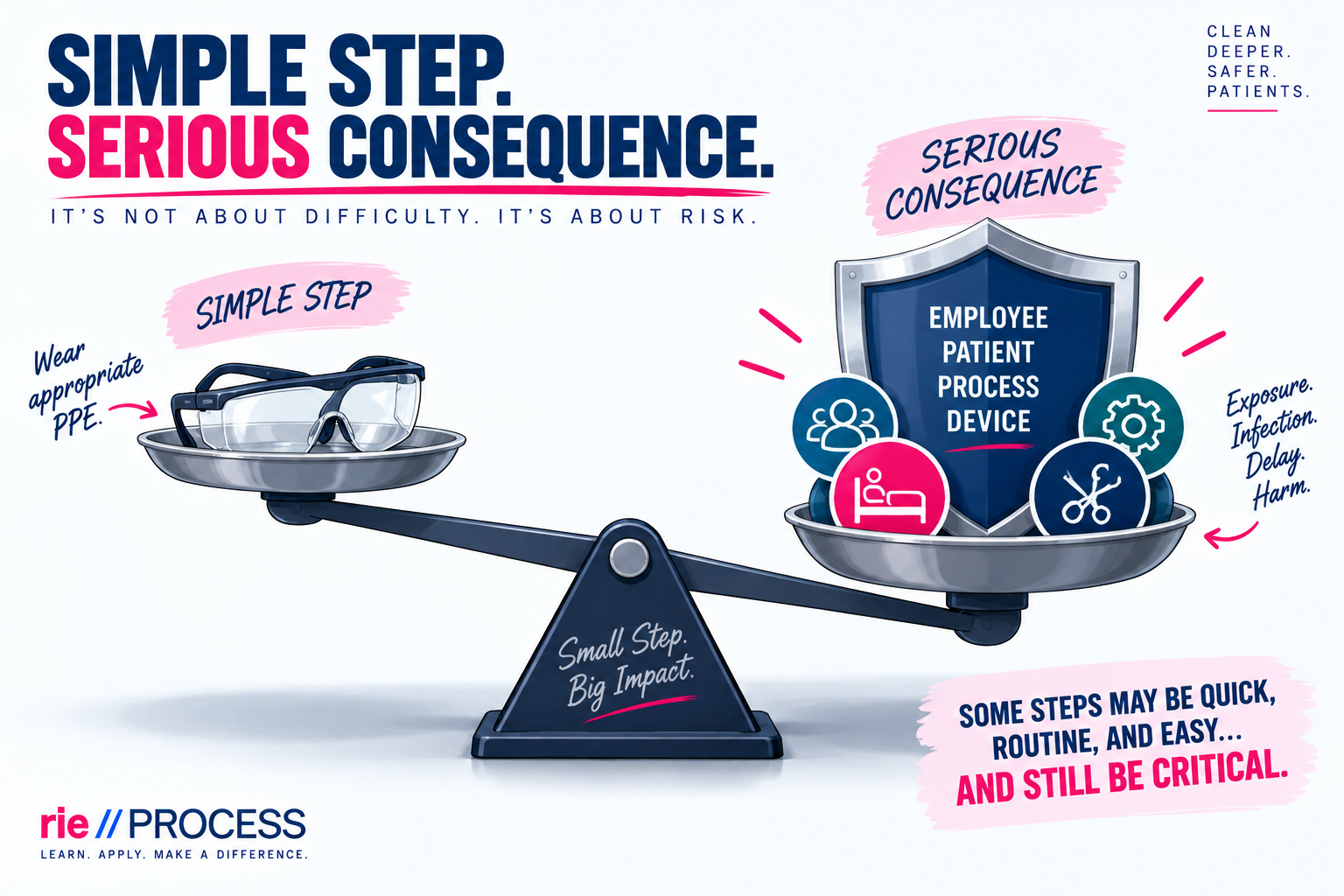
Risk ≠ Complexity
Safety-critical criteria are not necessarily the hardest steps in a procedure.
A step may be:
QUICK.
ROUTINE.
EASY TO DEMONSTRATE.
PERFORMED EVERY DAY.
…and still be critical because of what happens when it is missed.
a Simple Step Can Carry A Big Consequence.
Don’t rate importance by difficulty.
Rate it by the potential consequence of incorrect performance.
Competency design
Make Critical Performance Visible.
A competency should clearly identify the behaviors the evaluator actually needs to observe.
Instead of relying on a broad criterion such as:
“Performs the process safely.”
Define observable performance.
For example:
Weak
Uses appropriate PPE.
Stronger
Selects and wears PPE appropriate for the task and anticipated exposure throughout performance.
Or:
Weak
Operates the sterilizer correctly.
Stronger
Selects the required cycle and verifies cycle parameters before initializing the process.
If it matters enough to evaluate, make it observable.
Related learning:
Make the Risk Visible
The Evaluator Shouldn’t Have to Guess.
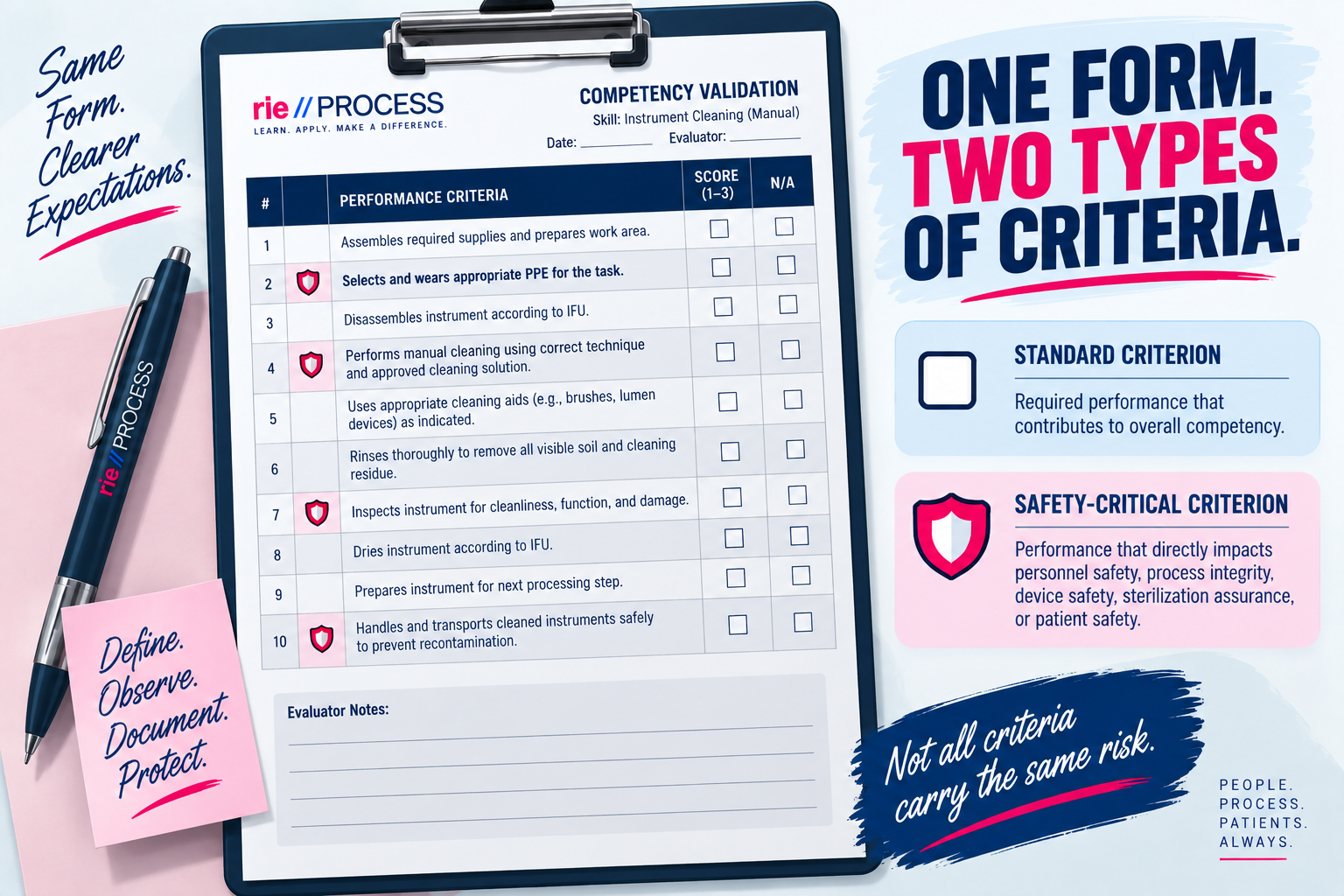
Safety-critical criteria should be identifiable within the competency tool.
A simple visual system can work:
SHIELD ICON
Safety-critical performance.
STANDARD CRITERION
Required performance that contributes to overall competency.
The purpose isn’t to decorate the form.
It is to make clear that certain failures require different response than an ordinary scoring deduction.
Critical Criteria Should Look Critical.
Scoring
Safety Shouldn’t Disappear into the math.
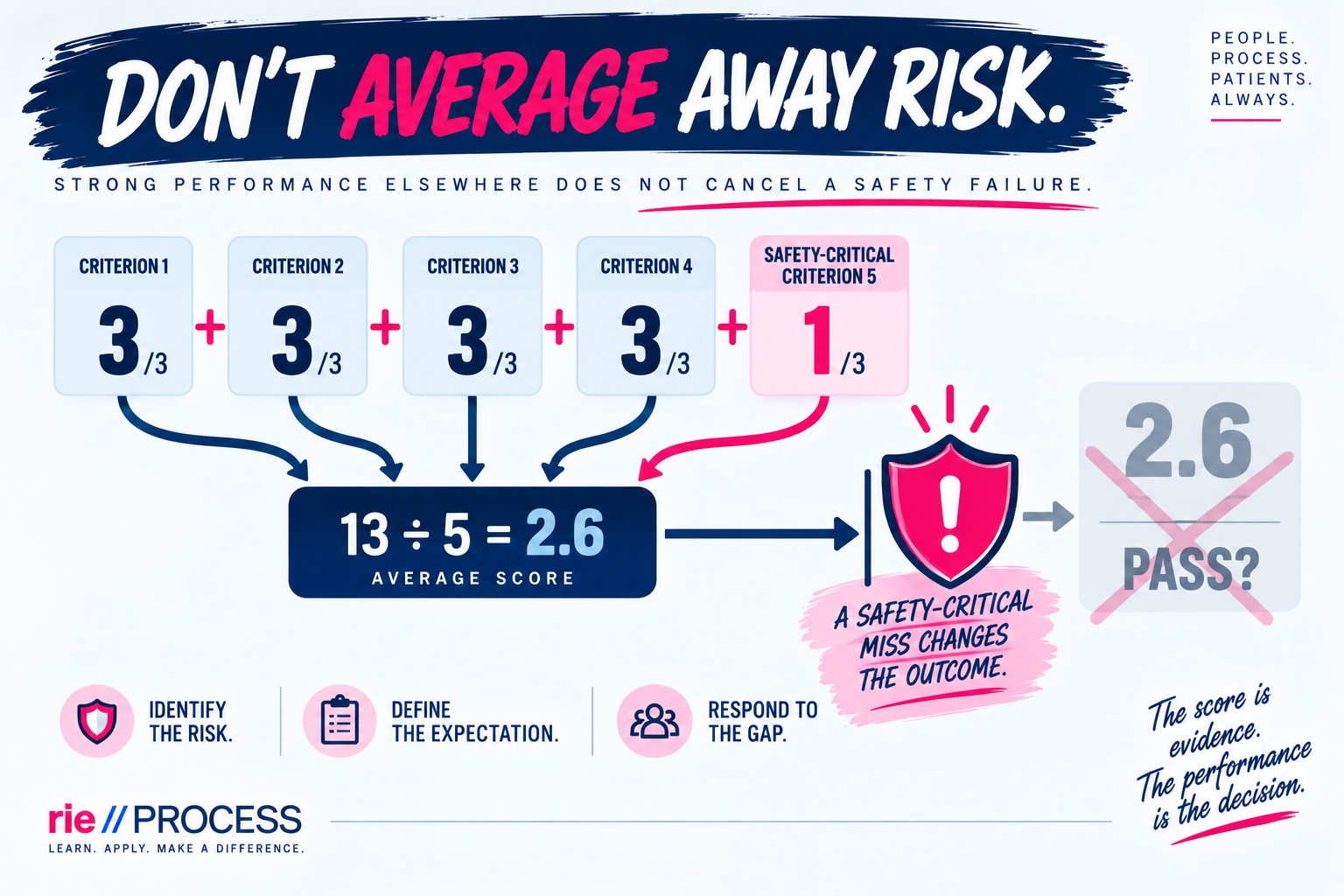
If a technician performs well across most of a competency but misses a safety-critical action, strong performance elsewhere should not automatically cancel that failure.
3 + 3 + 3 + 3 +1 ≠ “GOOD ENOUGH”
A scoring system should establish what happens when safety-critical performance is not demonstrated.
That might require:
STOPPING THE VALIDATION
COACHING OR REMEDIATION
REPEATING THE PERFORMANCE
REVALIDATING THE AFFECTED SKILL
DELAYING INDEPENDENT PRACTICE
The response should be defined by the organization’s competency system and the significance of the performance gap.
Assessment Thinking
What are we actually assessing?
A technician completes the entire process correctly except for one safety-critical step.
The final score exceeds the competency threshold.
Ask:
Did the technician demonstrate the required performance?
Did the technician recognize the safety-critical decision independently?
Would the same performance be acceptable without an evaluator present?
Does the total score accurately represent the risk you observed?
The score is evidence. The performance is the decision.
Evaluator Intervention
“They Did It After I Reminded Them.”
That tells you something.
It does not tell you the same thing as independent performance.
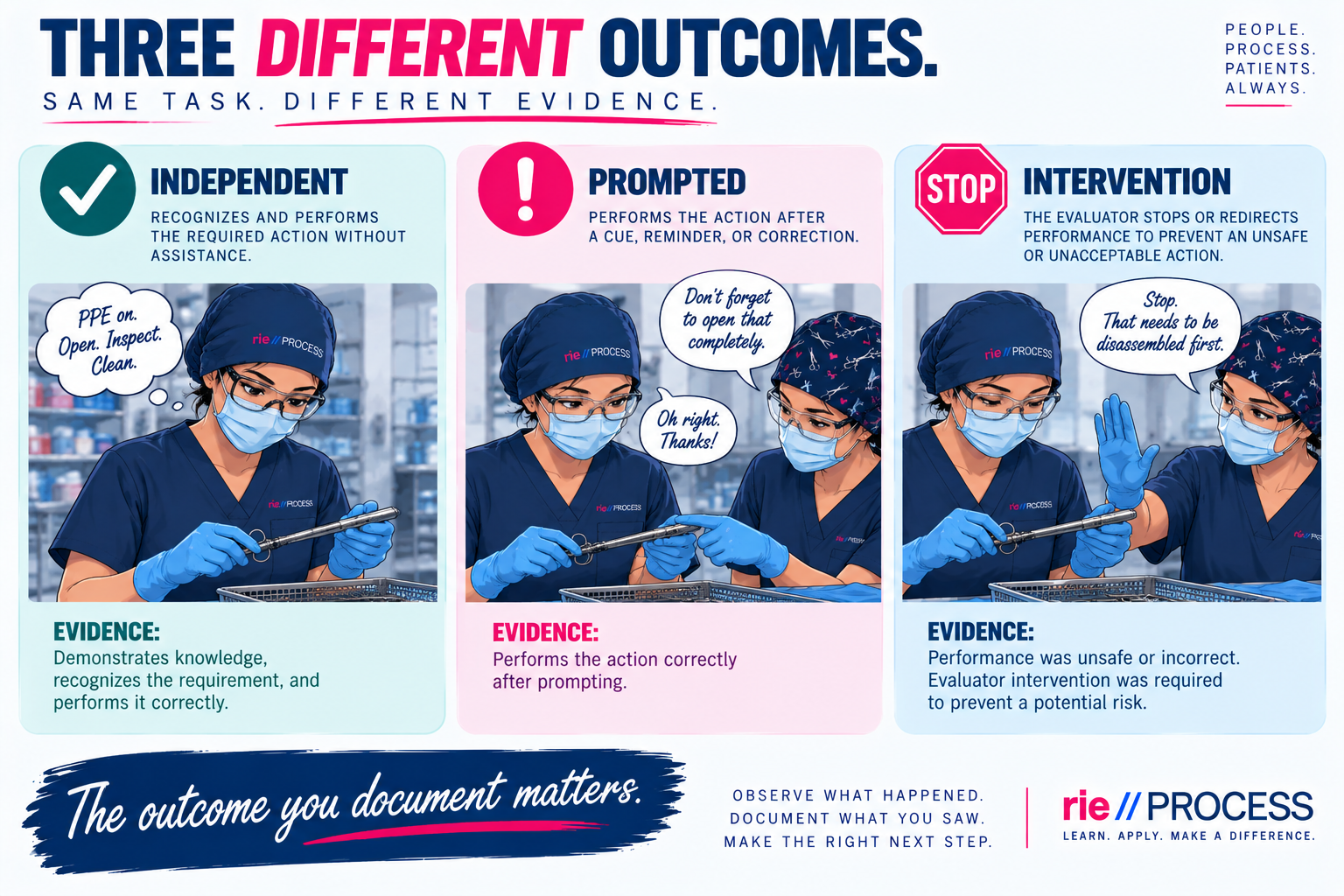
If an evaluator has to intervene to prevent a safety-critical error, document what actually occurred.
-
The technician recognizes and performs the required action without evaluator assistance.
-
The technician performs the action after a cue, reminder, or correction.
-
The evaluator stops or redirects performance to prevent an unsafe or unacceptable action.
These are different forms of evidence.
Don’t document independence you didn’t observe.
Safety Overrides Observation
Competency validation isn’t a test of how far an error can go.
An evaluator should not allow unsafe performance to continue simply to see whether the technician eventually recognizes the problem.
When intervention is necessary to protect:
THE EMPLOYEE
THE DEVICE
THE PROCESS
THE PATIENT
STOP THE PERFORMANCE.
Intervene appropriately.
Then document what was observed and determine the next step.
Observation never outranks safety.
After a Safety-critical miss
Don’t automatically start over. Fix what the evidence found.
A missed safety-critical criterion identifies a performance gap.
The next step should address that gap.
Depending on the situation, remediation might include:
-
Review the requirement or decision point.
-
Provide guided practice.
-
Allow the technician to repeat the skill.
-
Observe the affected performance again.
-
Evaluate related skills if the error suggests a broader knowledge or performance problem.
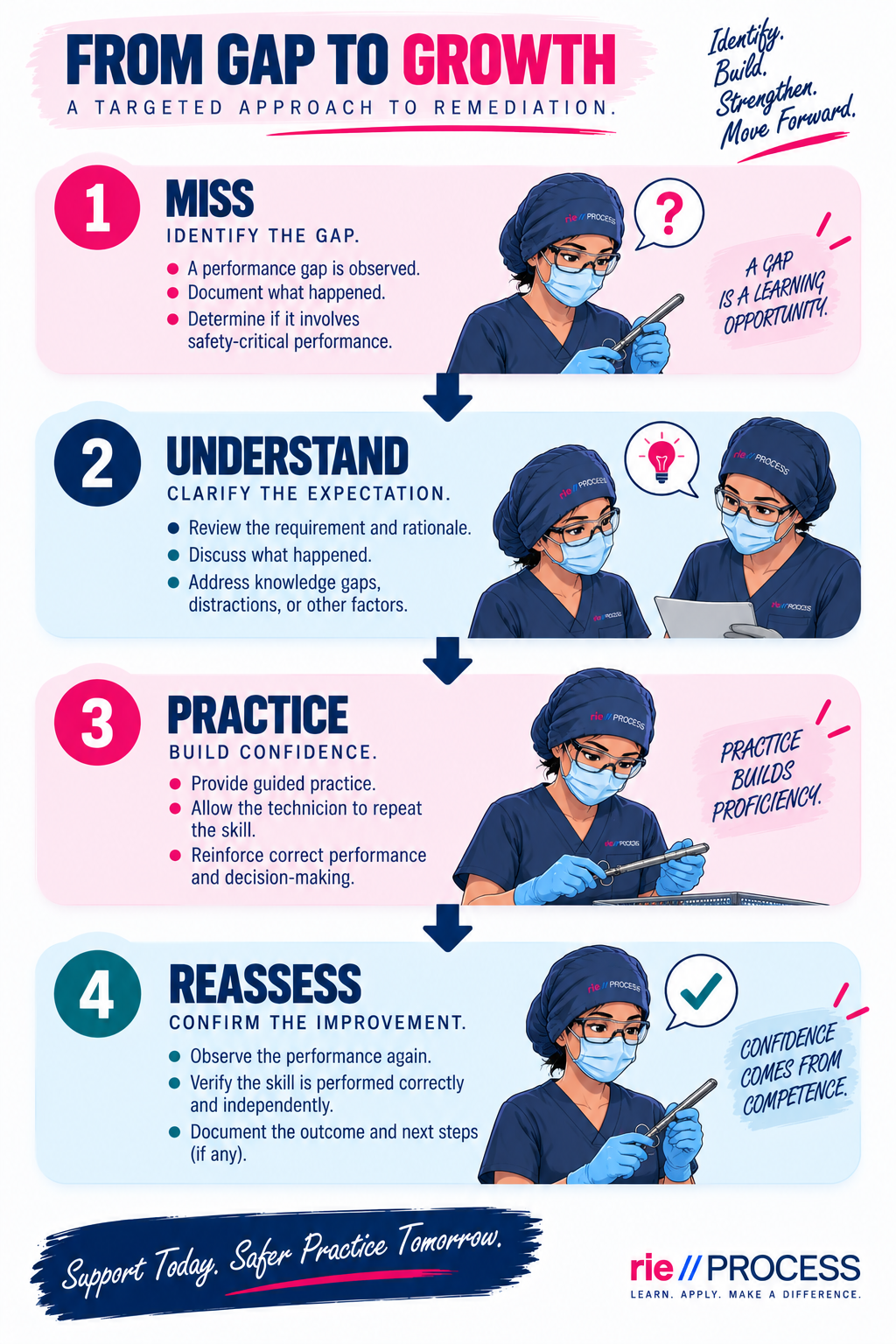
Remediation should be targeted, not punitive.
Look Beyond the Form
One successful demonstration answers one question.
Competency validation can provide evidence that a technician can perform a defined skill under observed conditions.
Readiness asks something broader:
Can the technician apply that performance consistently, independently, and in real work?
Safety-critical performance matters in both.
A technician may demonstrate a safety-critical step during validation but still need additional evidence before being considered ready for independent practice.
Competency is evidence. Readiness requires a pattern.
DESIGNING YOUR OWN COMPETENCIES
Before you mark it critical, ask:
01
Could incorrect performance create a meaningful safety risk?
02
Could the error compromise the device, process, sterile barrier, employee, or patient?
03
Would I allow the technician to continue independently after observing this failure?
04
Can the evaluator clearly observe and document the required behavior?
If the answers indicate that failure cannot reasonably be averaged away, the criterion may warrant safety-critical treatment.
use the designation deliberately.
The Big Idea
The Form Is Not The Competency.
A competency form organizes evidence.
A score summarizes evidence.
Neither replaces professional evaluation of the performance that actually occurred.
Identify the Risk.
Define the behavior.
Observe the performance.
Document the evidence.
Respond to the gap.
Safety-Critical performance should never disappear behind a passing score.
For Educators
Build a Stronger Competency System.
Competency Validation
Move beyond completed forms and design validation around observable performance.
Competency vs. Validation
Separate demonstrated skill from readiness for independent practice.
5-Minute Huddles
Bring focused process and quality conversations to your team.
Free Educational content from rie//PROCESS
Use this page for professional learning, educator development, and team discussion according to the rie//PROCESS free resource terms.