Quality + Improvement · Article
Not Every Error Needs An In-Service
When something goes wrong, education may be part of the solution. But first, we need to understand the problem we’re actually trying to solve.
By Valerie Reed, CHL, CRCST, CIS, CER
rie//PROCESS · September 2026
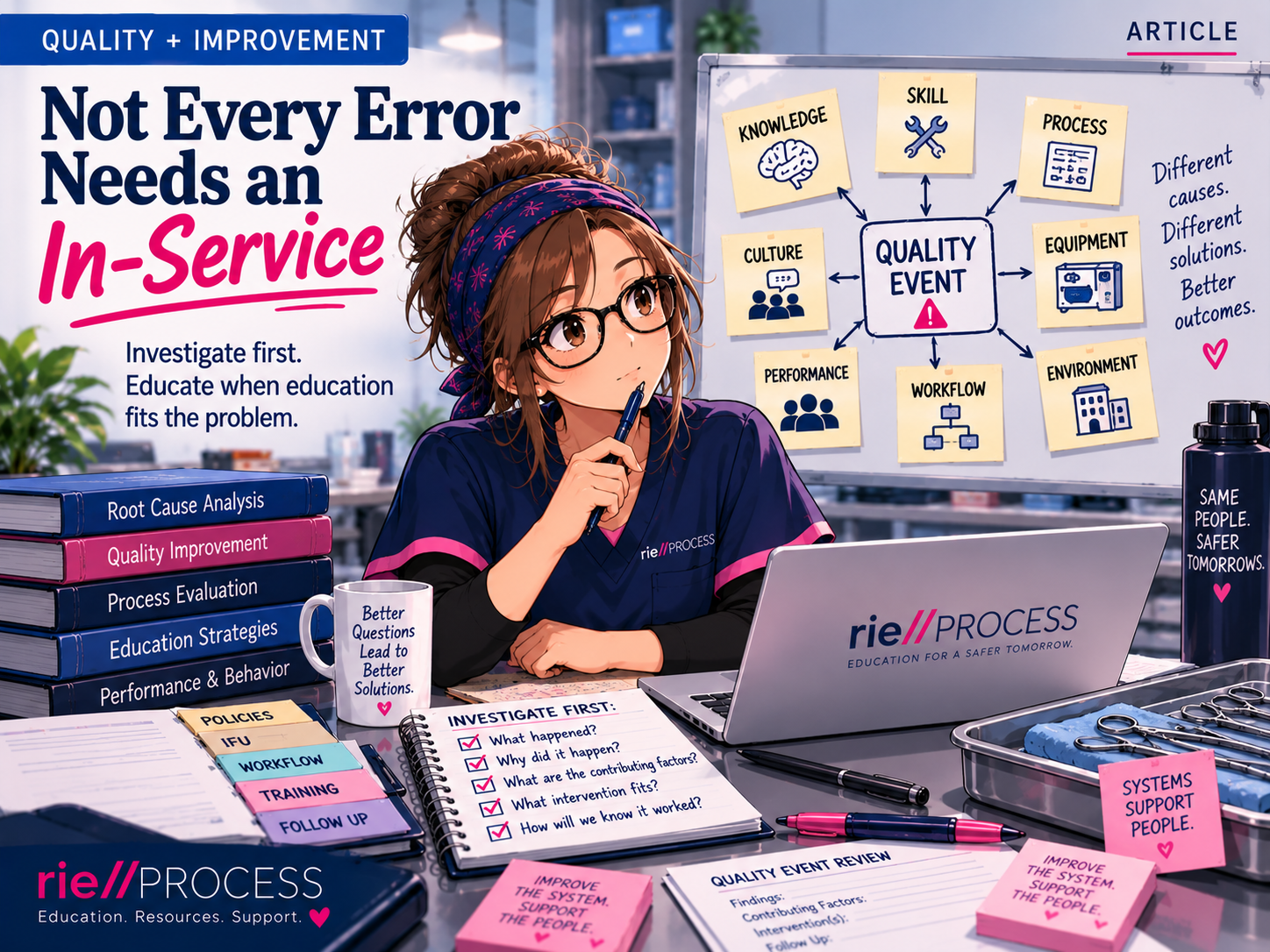
Something goes wrong in Sterile Processing.
A tray reaches the OR with an assembly error. Documentation is incomplete. A peel pouch is packaged incorrectly. An item is processed using the wrong cycle.
And somewhere, almost immediately, someone says:
“We need to do an in-service.”
Maybe we do.
But I've become much more interested in the question that needs to come before that:
Why did the error happen?
Because education is a reasonable response to a knowledge or skill gap.
It is a considerably less effective response to broken equipment, confusing procedures, inaccessible resources, inconsistent expectations, workflow barriers, or a dozen other problems that have very little to do with whether someone knows the correct process.
When every quality event automatically becomes an education problem, we can end up providing a lot of education without actually fixing very much.
When every quality event automatically becomes an education problem, we can end up providing a lot of education without actually fixing very much.
Education is an intervention
Education is one possible intervention.
Coaching is another.
So is changing a process.
Clarifying a procedure.
Repairing equipment.
Improving access to an IFU.
Adjusting workflow.
Standardizing expectations.
Addressing an individual's performance.
Sometimes several interventions are appropriate.
The important part is that the response should follow what we actually know about the event—not simply what is easiest to document afterward.
I think one reason we default to education is because it's actionable.
An error happens, and we want to respond.
We can create an in-service. We can gather the staff. We can review the procedure. Everyone signs the attendance sheet.
There.
Corrective action completed.
Except corrective action isn't supposed to mean we did something.
It should mean we did something that addressed the cause of the problem.
Corrective action isn’t supposed to mean we did something. it should mean we did something that addressed the cause of the problem.
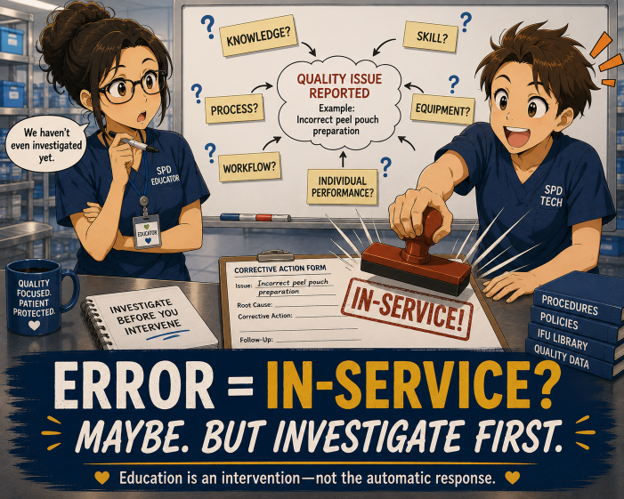
Investigate First
First: What Kind of Problem Are We Actually Looking At?
The immediate conclusion might be:
Staff need education on peel pouch preparation.
Maybe.
But let's investigate first.
Do technicians know the correct technique?
Were they originally trained on it?
Can they demonstrate it when asked?
Are expectations consistent across shifts and preceptors?
Is the appropriate packaging material readily available?
Is the equipment functioning correctly?
Has something changed in the process?
Are we seeing the problem throughout the department—or repeatedly from one person?
Is there a workload or workflow condition contributing to the behavior?
Are technicians knowingly using a shortcut?
Those answers lead us toward very different interventions.
If technicians genuinely don't know the correct technique, education makes sense.
If they know it but cannot perform it correctly, we may be looking at a skill or competency gap requiring practice and validation.
If one technician is consistently performing the task incorrectly, we may need individual coaching, not a department-wide in-service.
If different preceptors are teaching different techniques, we have a standardization problem.
If the process makes correct performance unnecessarily difficult, we may have a workflow problem.
If someone knows the expectation and repeatedly chooses not to follow it, another PowerPoint probably isn't going to perform a miracle.
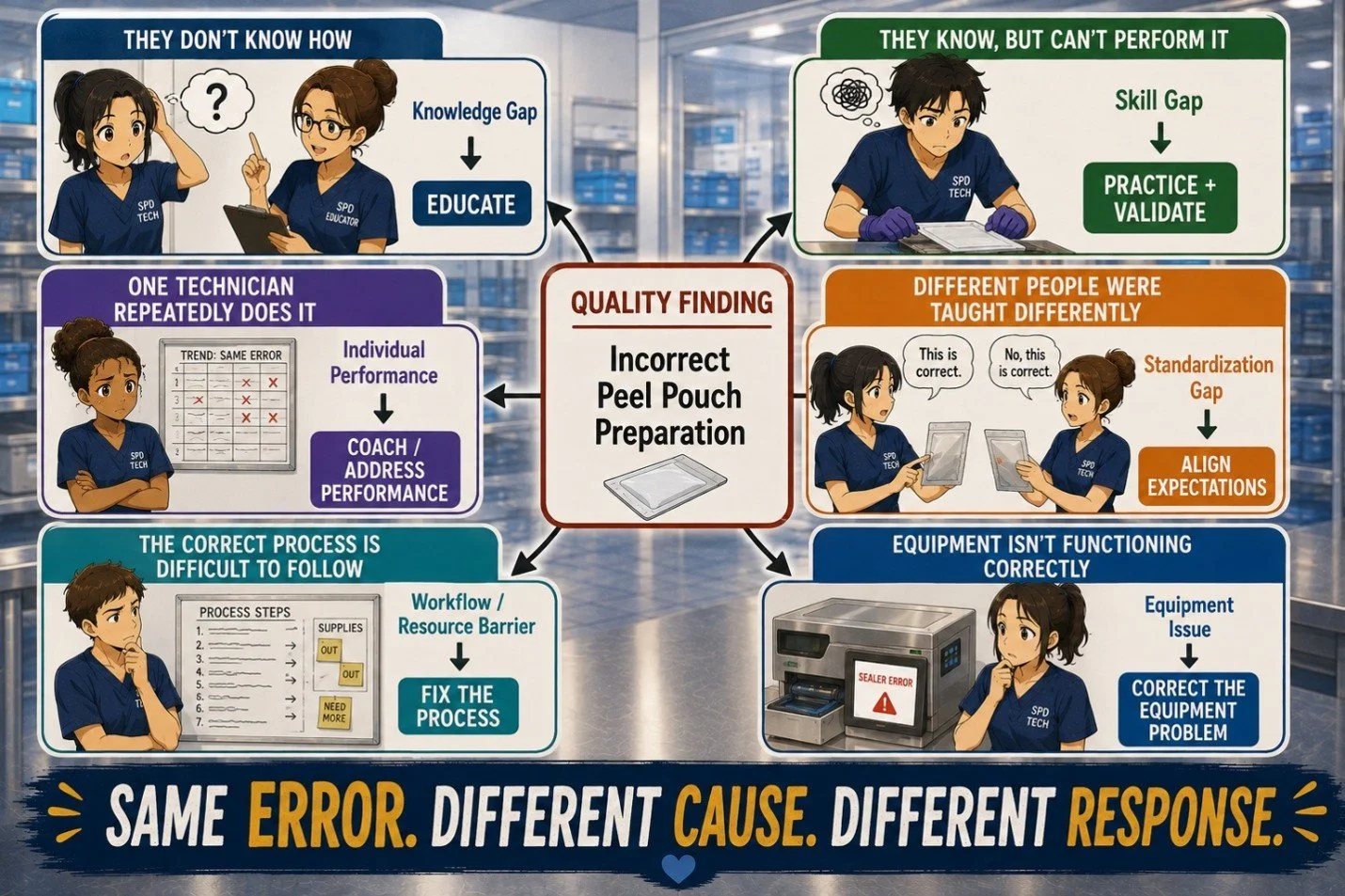
KNOWLEDGE GAP
→ Educate
SKILL GAP
→ Practice + validate
INDIVIDUAL PERFORMANCE
→ Coach/address performance
STANDARDIZATION GAP
→ Align expectations
WORKFLOW/RESOURCE BARRIER
→ Fix the process
EQUIPMENT ISSUE
→ Correct the equipment problem
Same quality finding. Very different causes. Very different responses.
“Everyone Needs Education” Can Hide the Actual Problem
Blanket education feels safe because it treats everyone equally.
But equal isn't always appropriate.
If 59 technicians consistently follow a process and one technician doesn't, educating all 60 may create a beautiful attendance record while avoiding the uncomfortable conversation we actually need to have.
On the other hand, if the same error appears across multiple employees, shifts, or work areas, blaming individual performance would be equally misguided.
Now I want to know what those events have in common.
Maybe the written procedure isn't clear.
Maybe training has been inconsistent.
Maybe the IFU is difficult to locate.
Maybe a piece of equipment is behaving differently than expected.
Maybe we've created a workaround so common that it has quietly become the unofficial process.
Patterns matter.
Before deciding who needs education, we should understand who is actually affected by the problem.
Sometimes that's one person. Sometimes it's a shift. Sometimes it's a particular work area. Sometimes it really is everyone.
But “everyone” should be a conclusion—not our default setting.
Knowing ≠ Doing
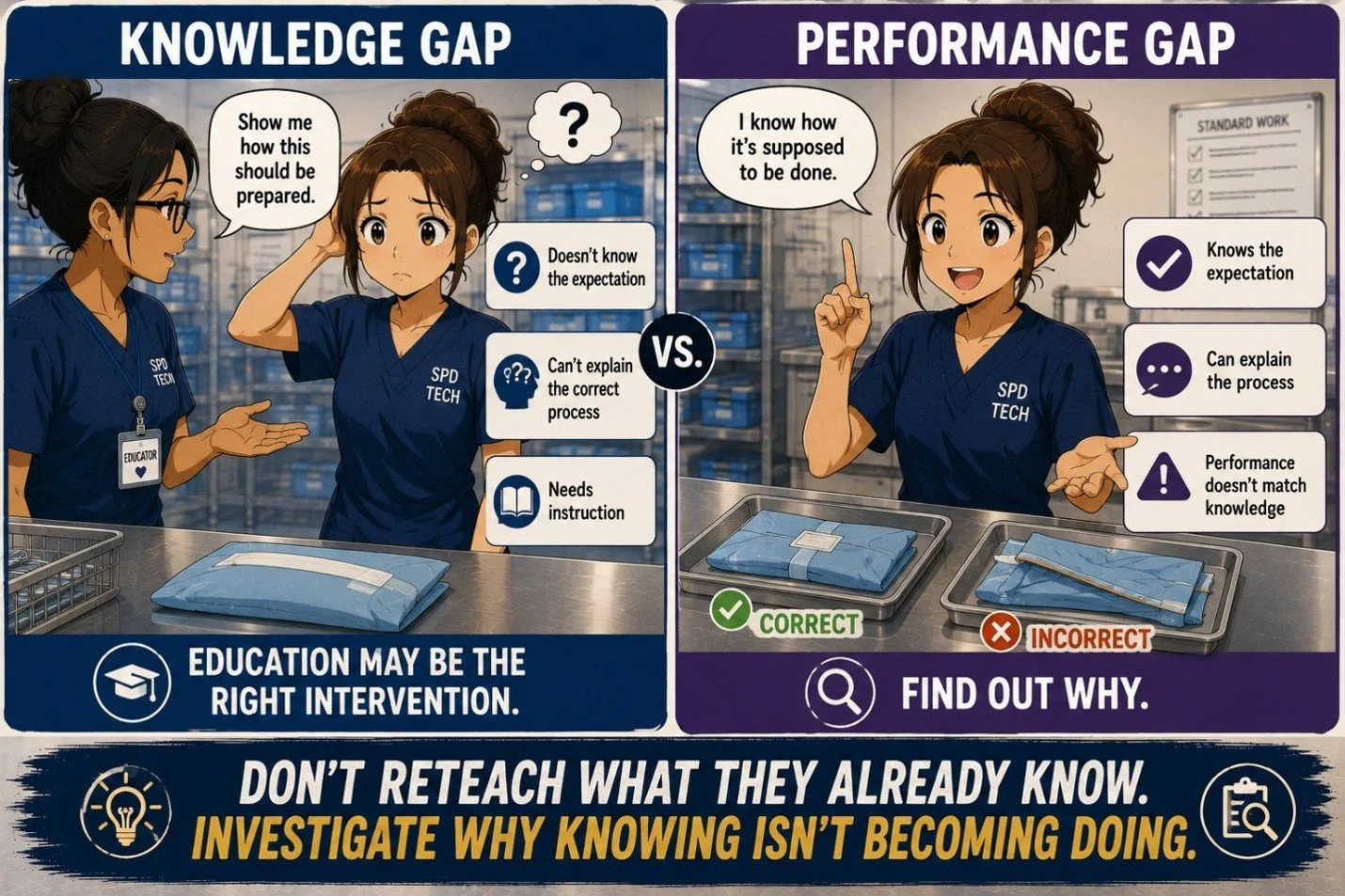
A knowledge Gap and a Performance gap aren’t the same thing.
This distinction is particularly important to me.
Suppose a technician performs a process incorrectly. We ask them to explain the correct process. And they explain it perfectly. That's useful information - they may not have an education problem. They know the expectation.
Now we need to understand why their performance doesn't match their knowledge.
Maybe the correct process takes longer and they've developed a shortcut.
Maybe they feel pressured to meet production expectations.
Maybe the tools or supplies they need aren't consistently available.
Maybe the incorrect method has become normalized in the work area.
Maybe they were corrected previously but the behavior returned.
Maybe this really is an individual accountability issue.
Whatever the answer is, simply teaching the same information again doesn't address the gap between knowing and doing.
That's why I think quality review and education need to talk to each other. The quality finding tells us what happened. Investigation helps us understand why.
Only then should we decide what education - if any - is appropriate.
Yes, Sometimes It Is Education.
None of this is an argument against in-services.
I am, after all, an educator. I enjoy an in-service more than is probably reasonable.
There are absolutely situations where education is the right intervention. A new device or process is introduced. A policy changes. Staff demonstrate inconsistent understanding of a requirement. Quality findings reveal a widespread knowledge gap. A rarely encountered process needs reinforcement. A new risk has been identified.
Those are legitimate educational needs.
But even then, I want to ask one more question:
What should employees be able to do differently after this education?
Because if we're responding to a quality problem, attendance alone doesn't close the loop.
If the issue involved technique, perhaps we need return demonstration.
If it involved decision-making, perhaps scenarios make more sense.
If it involved routine performance, perhaps we need follow-up observation.
If it involved documentation, perhaps we need to review subsequent records.
The educational response should match both the cause of the error and the behavior we're trying to change.
Sometimes Education is Exactly the Right Answer.
Technique → Return demonstration
Decision-making → Scenarios
Routine performance → Follow-up observation
Documentation → Subsequent record review
The Audience Should Follow the Problem, Too.
Another thing I've started questioning is the assumption that every educational response needs to be department-wide.
Sometimes targeted education is better education.
If a quality trend involves one work area, train that work area.
If a process change affects a specific group, focus there.
If several technicians demonstrate the same gap, work with those technicians.
If one person needs coaching, coach one person.
Department-wide education absolutely has a place when the issue is widespread or the information genuinely applies to everyone. But repeatedly educating people on problems they aren't having creates noise. And when staff receive enough irrelevant “mandatory education,” something predictable happens:
They stop treating it as meaningful.
It becomes another form. Another signature. Another thing to click through.
Then when we genuinely need their attention, we're competing with the training fatigue we helped create.
Repeatedly educating people on problems they aren’t having creates noise.
Close the loop
Did the Intervention Work?
This is where quality and education become much more useful together.
If a quality finding triggered an intervention, we should eventually ask:
Did the problem improve?
Suppose tray audits reveal a recurring assembly issue. We investigate and identify a knowledge gap. We provide targeted education and validate understanding. Then we continue auditing.
If the error rate decreases, that's evidence that our intervention may have addressed the problem.
If it doesn't? That's important too.
It means we need to look again.
Maybe the educational approach wasn't effective.
Maybe we misidentified the cause.
Maybe another barrier exists.
Maybe knowledge wasn't the problem after all.
What I don't want to do is repeatedly deliver the same education, collect another round of signatures, and call each one a new corrective action.
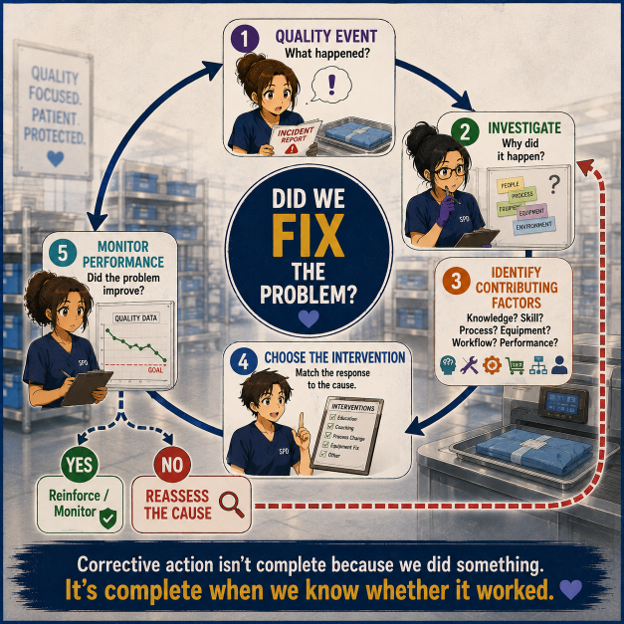
At some point, the lack of improvement is telling us something. We should listen.
The Educator’s Role
“This Isn’t An Education Problem.”
I think this is an important part of the educator role that doesn't get discussed enough. Being responsible for education doesn't mean every problem belongs to education. Sometimes the most useful thing an educator can contribute is helping determine whether learning is actually the issue.
We can ask:
Do employees know the expectation?
Have they been taught the process?
Can they demonstrate it correctly?
Do they know where to find the appropriate resources?
Is the problem widespread or isolated?
Has previous education changed performance?
Those questions help separate a learning need from a process, equipment, workflow, leadership, or individual performance issue. And if the evidence says this isn't an education problem?
We should be comfortable saying so.
That's not refusing to help. That's helping the organization choose an intervention that has a better chance of working.
The Goal Isn’t to PRove We Responded.
Healthcare generates documentation for good reasons.
When something goes wrong, we need evidence that it was identified, evaluated, and addressed. But there is a subtle trap in focusing so heavily on documenting our response that we stop evaluating whether the response was effective.
An attendance sheet can prove that an in-service occurred. It cannot prove that the in-service addressed the cause of the event.
A completed competency can demonstrate performance under defined conditions. It doesn't automatically explain why the original error occurred.
A corrective-action record can show that we took action. It doesn't necessarily show that we took the right action.
The goal isn't:
Error → Education → Signature → Closed
It should look more like:
Error → Investigate → Identify contributing factors → Choose the appropriate intervention → Evaluate performance → Reassess if needed
Sometimes education will sit right in the middle of that process.
Sometimes it won't.
The Takeaway
Let the Error Tell You What It Needs.
I still believe strongly in education. Probably more strongly than I did before.
But believing in education also means being thoughtful about when and how we use it.
An in-service is not a universal antidote for quality events.
Sometimes we need to teach.
Sometimes we need to coach.
Sometimes we need to validate competency.
Sometimes we need to fix the process.
Sometimes we need to fix the equipment.
Sometimes we need to clarify expectations.
And sometimes we need to have an individual performance conversation that no amount of department-wide education is going to replace.
So when the next quality event happens and someone inevitably says: “We need to do an in-service.”
Maybe the answer is yes.
But first, I want to ask: “What makes us think this was an education problem?”
Because education should follow the error.
It shouldn't automatically follow the incident report.
Keep Following the Question.
Keep Exploring
Related Article
When Training Becomes a Checkbox
Education happened. But did it actually change performance?
For Educators
Competency Validation
Move beyond completed forms toward meaningful evidence of performance.
Team Education
The 5-Minute Huddle
Turn one focused SPD concept into a short, useful team conversation.