EDUCATION + PRECEPTING · ARTICLE
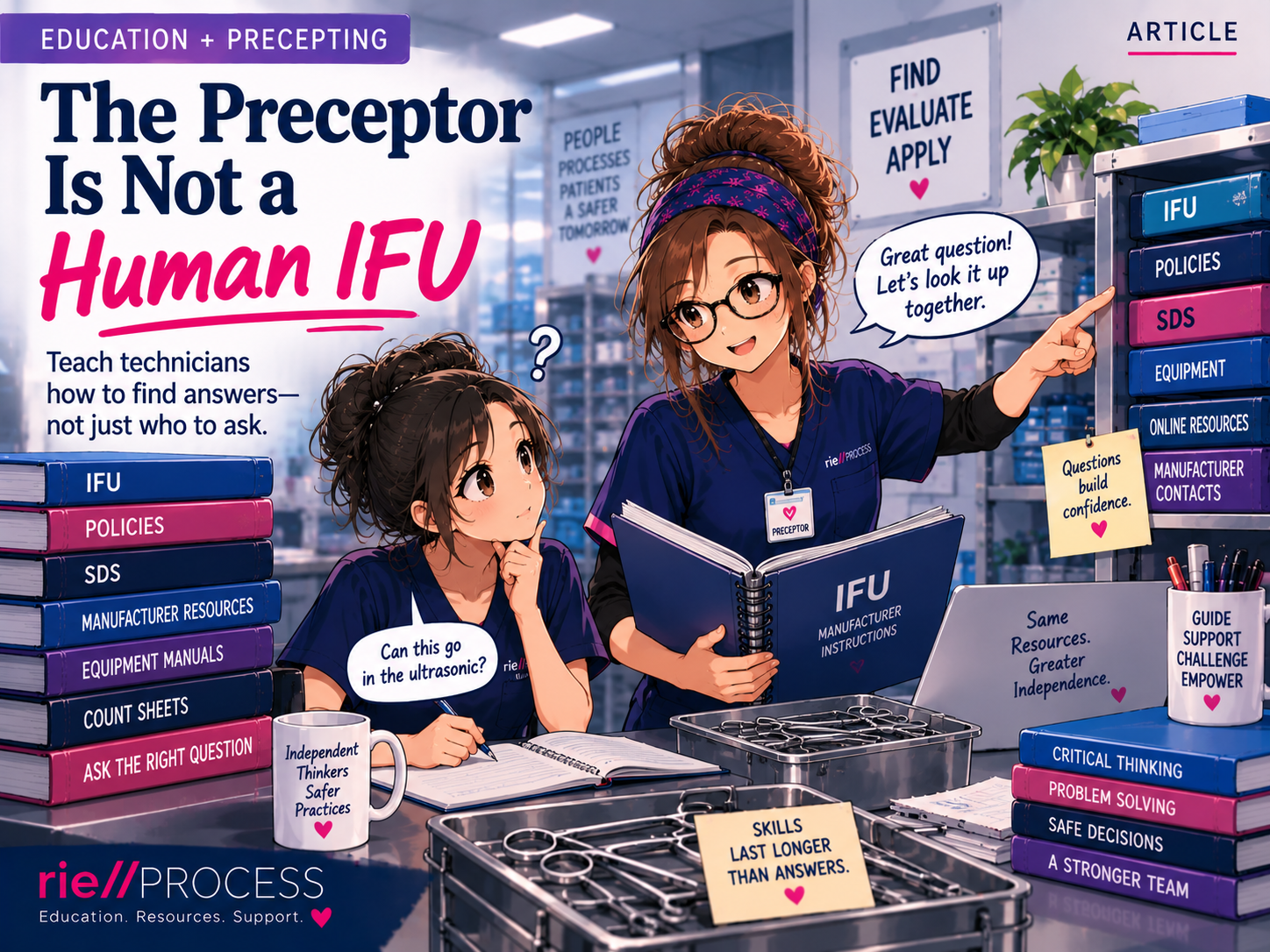
The Preceptor Is Not a Human IFU
Good preceptors don’t just give technicians answers. They teach them how to find reliable information, reason through uncertainty, and eventually work without someone standing beside them.
By Valerie Reed, CHL, CRCST, CIS, CER
rie//PROCESS · September 20226
One of the hardest things for an experienced Sterile Processing technician to learn as a preceptor may be this:
You do not have to answer every question immediately.
In fact, sometimes giving the answer is the least helpful thing we can do.
That sounds strange. Preceptors are supposed to teach. New technicians have questions. Experienced technicians have answers. Surely the fastest route from Point A to Point B is simply telling them what they need to know.
And during early training, sometimes it is.
But if every question gets an immediate answer from the person standing beside them, we may accidentally teach something we never intended:
When you're unsure, find the person who knows.
What we really need technicians to learn is:
When you're unsure, know how to find out.
That distinction has changed the way I think about precepting.
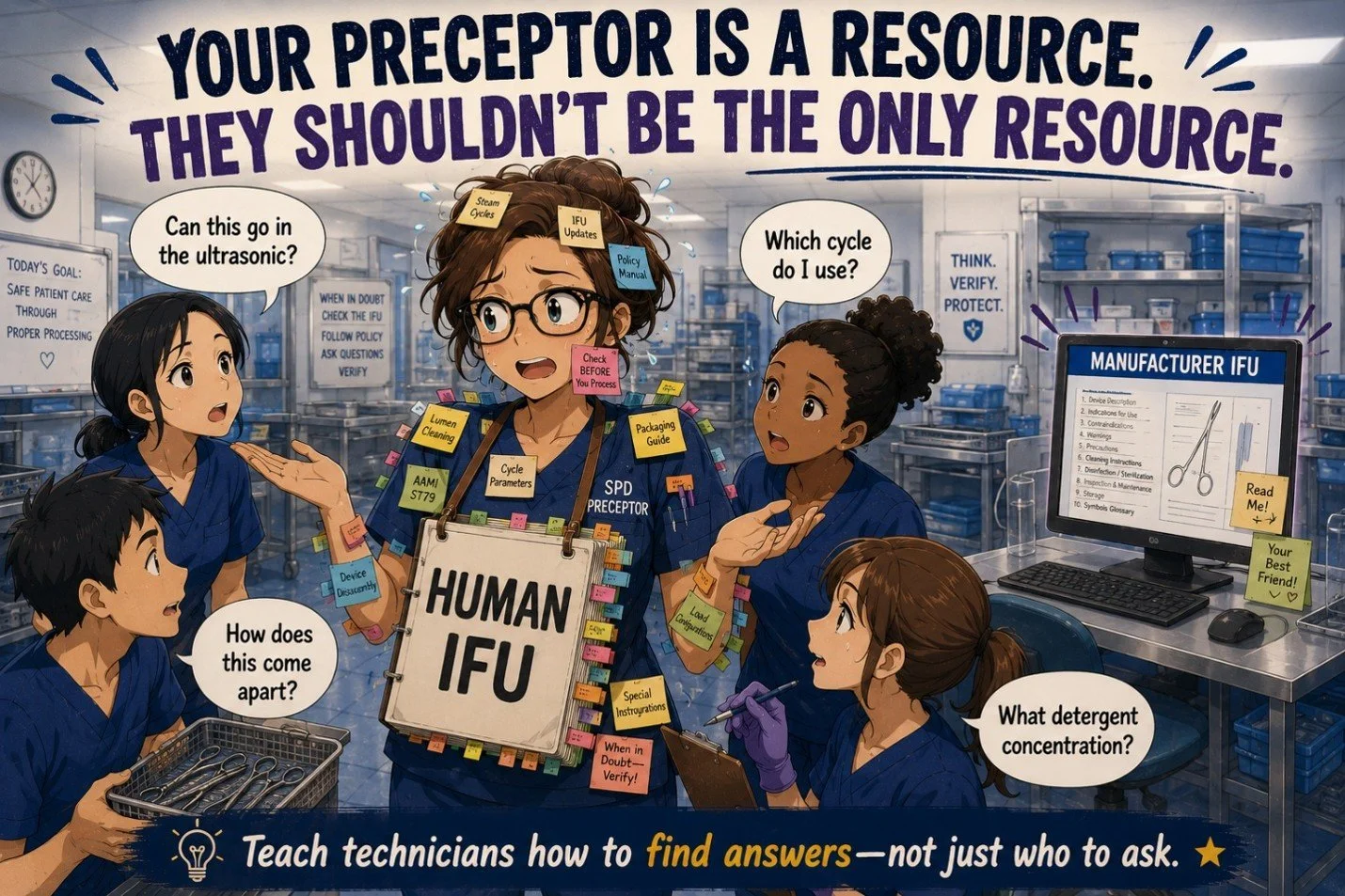
Knowing the Answer Isn’t the Same as Knowing How to Find it
Sterile Processing is full of information that cannot—and should not—live entirely in someone's memory.
Instructions for Use change. Devices vary. Equipment has specific requirements. Facility policies establish local expectations. Processing decisions can depend on details that aren't obvious simply by looking at an instrument.
Yet experienced technicians accumulate an enormous amount of working knowledge. After you've seen the same instrument hundreds of times, the answer can feel automatic.
A new technician asks: “Can this go in the ultrasonic?”
And the experienced technician knows the answer. So we answer. Question solved.
Except another device appears tomorrow. And another one next week. Eventually the technician will encounter something the preceptor hasn't specifically taught them.
If our training has primarily taught them to remember answers, they're going to have a problem. If we've taught them how to find, evaluate, and apply reliable information, they have somewhere to go next.
That is a much more durable skill.
If we teaach technicians to remember answers, they will eventually run out of answers.
If we teach them how to find, evaluate, and apply reliable information, they have somewhere to go next.
Devloping independence
The Goal Changes As the Technician Develops.
Sterile Processing is full of information that cannot—and should not - live entirely in someone's memory.
Instructions for Use change. Devices vary. Equipment has specific requirements. Facility policies establish local expectations. Processing decisions can depend on details that aren't obvious simply by looking at an instrument. Yet experienced technicians accumulate an enormous amount of working knowledge. After you've seen the same instrument hundreds of times, the answer can feel automatic.
A new technician asks: “Can this go in the ultrasonic?”
And the experienced technician knows the answer. So we answer. Question solved.
Except another device appears tomorrow. And another one next week.
Eventually the technician will encounter something the preceptor hasn't specifically taught them.
If our training has primarily taught them to remember answers, they're going to have a problem.
If we've taught them how to find, evaluate, and apply reliable information, they have somewhere to go next.
That is a much more durable skill.
The Goal Changes as the Technician Develops
I don't think every question from a new technician should be answered with another question.
That would be exhausting.
Imagine someone's first morning in Decontamination:
“Where are the brushes?”
“Where do you think the brushes are?”
Please don't do this to people.
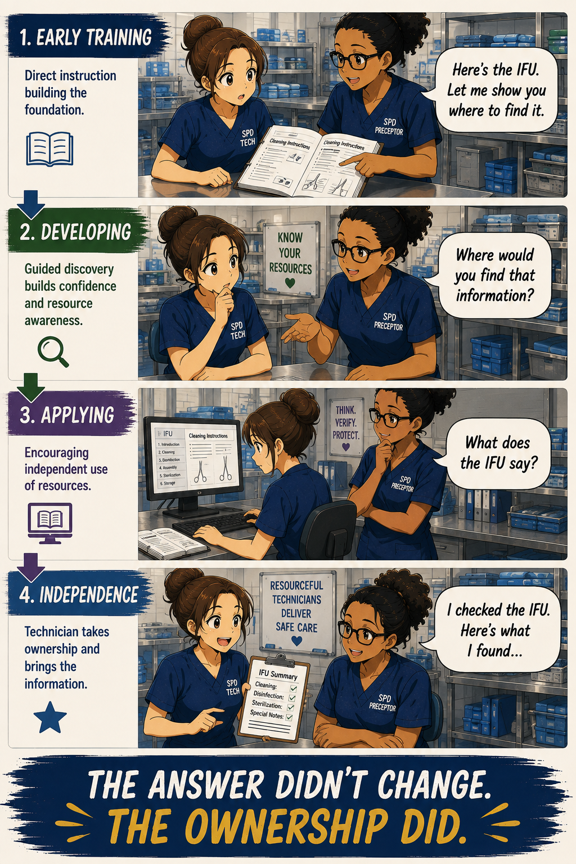
Early training requires direct instruction. New technicians need orientation to the department, demonstrations, explanations, clear expectations, and plenty of guidance.
But as foundational knowledge develops, the preceptor's response should begin to change.
Early on, it may be:
“Here's the IFU. Let me show you how to find the cleaning instructions.”
Later:
“Where would you find the manufacturer's cleaning instructions?”
Then:
“What does the IFU say?”
Eventually:
“Walk me through how you made that decision.”
The information hasn't become less important.
The ownership of finding and applying it has shifted.
That is the point.
Teach Resource Use as a Skill
We often talk about IFU compliance as though it is simply a rule:
Follow the manufacturer's IFU.
Of course.
But for a developing technician, “follow the IFU” actually contains several skills.
They need to recognize when they need one.
They need to know where to find it.
They need to confirm that they have the instructions for the correct device.
They need to locate the relevant section.
They need to interpret the processing requirements.
They need to compare those requirements with the equipment, chemicals, accessories, and processes available in their facility.
And they need to recognize when something doesn't line up.
That's not just compliance.
That's information literacy for Sterile Processing.
The same principle applies beyond manufacturer instructions.
A technician should learn when to consult facility policy, equipment instructions, chemical labeling, Safety Data Sheets, count sheets, tracking systems, reference materials, supervisors, educators, Infection Prevention, manufacturers, or other appropriate resources.
A good preceptor doesn't simply become another one of those resources.
A good preceptor teaches the technician how to navigate them.
Ask questions That Move the Thinking Forward
There's a big difference between productive questioning and turning every training interaction into an interrogation. The goal isn't to catch the technician not knowing something. The goal is to help them organize what they already know and identify what they still need.
Some of the most useful preceptor questions are remarkably simple:
“What do you know so far?”
“What information do you still need?”
“Where could you find that?”
“What does the IFU say?”
“What are you seeing that concerns you?”
“What would make you stop?”
“Who would you escalate this to?”
“Walk me through your reasoning.”
Those questions do something an immediate answer can't.
They make the technician practice the thinking.
And that matters because eventually the preceptor won't be standing beside them.
Sometimes the Wrong Answer is useful
This is where precepting gets uncomfortable.
Sometimes a technician needs enough space to make a decision that isn't perfect.
Not an unsafe decision. Not a decision that compromises an instrument, a process, an employee, or a patient. But a decision that may be inefficient, incomplete, or simply not the approach the experienced technician would have chosen.
Experienced technicians are very good at seeing where something is headed. That makes it incredibly tempting to intervene early. You can see the inefficient workflow developing from across the room.
Your entire nervous system is screaming:
JUST TELL THEM.
But if the consequence is harmless, there can be value in allowing the technician to work through it.
Maybe they organize their workload poorly and have to reorganize it. Maybe they look in the wrong reference location before finding the correct one. Maybe they take three steps to reach an answer an experienced technician could find in one.
That isn't necessarily failed training. Sometimes that's learning.
The preceptor can follow with:
“How did that go?”
“What made that difficult?”
“What would you do differently next time?”
Now the technician isn't merely receiving someone else's solution.
They're building their own mental model.
Productive Struggle Has a Safety Boundary
This is the distinction that matters most.
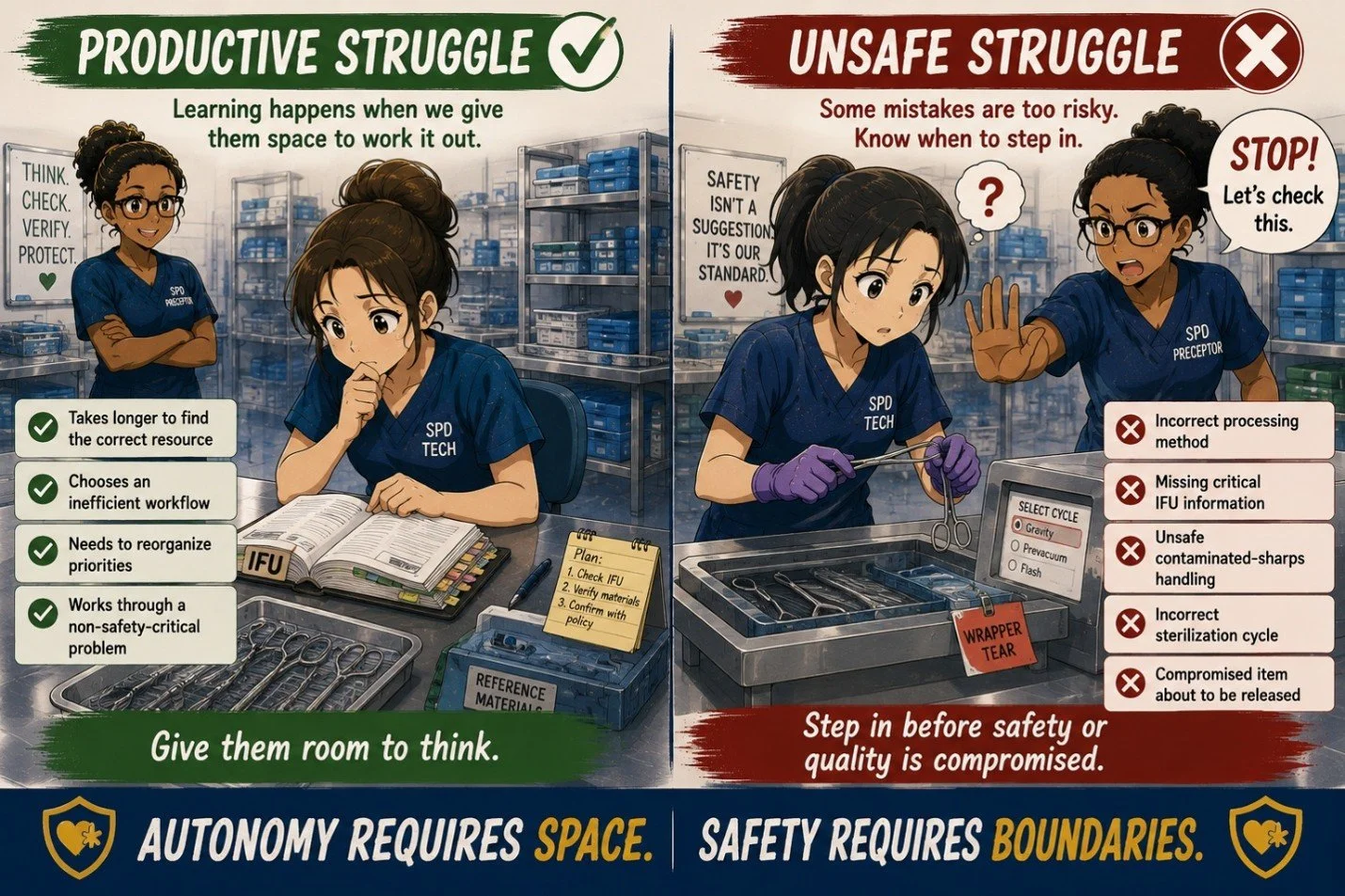
There is a difference between productive struggle and unsafe struggle.
Productive struggle gives the learner room to think, search, make low-risk decisions, recognize inefficiency, and solve problems.
Unsafe struggle allows an incorrect action to continue when it could compromise safety or quality.
If a technician is about to use an incompatible process, mishandle a contaminated sharp, release something that should not be released, select an inappropriate cycle, compromise a package, or continue when critical information is missing, this is not the moment for a fascinating educational experiment.
INTERVENE.
The learning conversation can happen afterward.
Patient safety does not need to participate in the return demonstration.
That boundary is important because “let them figure it out” can become just as problematic as answering everything for them.
Good precepting requires judgment about when to step back and when to step in.
The Preceptor Should Become Less Necessary
This may be the strangest measure of successful precepting: Over time, the technician should need you less.
Not because they know everything.
They won't.
None of us do.
They should need you less because their first response to uncertainty has changed.
Instead of: “What do I do?” we start hearing: “I wasn't sure, so I checked the IFU.”
Or: “I found the policy, but I'm not sure I'm interpreting this section correctly.”
Or: “The IFU requires something we don't appear to have available, so I stopped and came to you.”
That is a very different conversation.
Now the technician isn't handing the problem to the preceptor. They're bringing the preceptor into a problem they've already begun to investigate.
That's growth.
And eventually, many routine questions stop becoming questions at all.
“I Don’t Know” Can Be a Very Good Answer
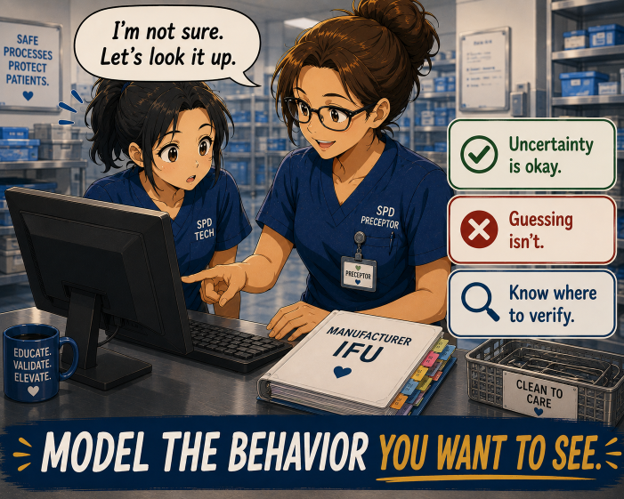
There's another behavior I think preceptors have an opportunity to model.
Sometimes we don't know. Experienced technicians included. And pretending otherwise may teach the worst possible lesson.
If a trainee asks me something I don't know, I would much rather say:
“I'm not sure. Let's look it up.”
That sentence demonstrates several things at once.
It shows that uncertainty is acceptable.
It shows that guessing isn't.
It shows that reliable information matters more than appearing knowledgeable.
And it demonstrates exactly what we want the technician to do when they eventually encounter uncertainty on their own.
There is professional confidence in knowing an answer.
There is also professional confidence in knowing when you don't have one.
Sterile Processing needs both.
We Aren’t Training Technicians to Work Without Help
Independence can be misunderstood.
The goal isn't to develop a technician who never asks questions. A technician who never asks for help isn't necessarily independent.
They may simply be very confident while being spectacularly wrong.
The goal is to develop someone who can distinguish between:
I can handle this.
I need to verify this.
and
I need help.
That requires technical knowledge, but it also requires judgment, resourcefulness, humility, and an understanding of one's own limits. Preceptors help build those habits every time they decide whether to provide an answer, ask a question, point toward a resource, coach the next step, or intervene.
Those tiny interactions accumulate.
Eventually they become the technician's approach to uncertainty.
The Best Answer Isn’t Always the Answer
Preceptors carry an enormous amount of knowledge, and sharing that knowledge is an important part of the role. But the goal isn't to create a technician who can function beautifully as long as their favorite experienced coworker is standing three feet away. We're preparing them for the moment when that person isn't there.
So sometimes the most useful response to a question isn't:
“Here's the answer.”
It's:
“Where would you find the answer?”
Then give them the time to look.
Let them read. Let them reason. Let them come back with what they found.
Coach when they need coaching. Direct when they need direction. Intervene when safety requires it.
And gradually, deliberately, make yourself less necessary.
Because the preceptor was never supposed to become the technician's human IFU.
Our job is to teach them what to do when they don't already know what to do.
Keep Exploring
Keep Building Independence
Related Article
One Onboarding Program, Two Different Jobs
See how structured onboarding can shift from supported skill-building toward independent application and readiness.
For Educators
Competency vs. Readiness
Explore why demonstrating a skill with support isn’t necessarily the same as being ready for independent practice.
5-Minute Huddle
Memory Is Not an IFU
Start a quick team conversation about knowing when experience needs to give way to verification.