Code Breaker | Question Strategy
Common Exam Traps
The wrong Answer Isn’t Always Obviously Wrong.
Certification questions are harder when several choices sound reasonable.
The trick isn’t to become suspicious of every answer.
It’s to recognize when an answer is true, familiar, or possible - but still doesn’t answer the question being asked.

Don’t Get Distracted
Good Distractors Sound Good.
A strong distractor usually isn’t nonsense.
It may be:
True.
Something you recognize.
An action that belongs somewhere in the process.
Something you’ve actually seen done.
But none of those automatically make it the correct answer.
Don’t Ask Only: “Is this true?”
Ask: “Does this answer this question?”
Your job isn’t to find an answer you can defend.
Your job is to identify the strongest answer supported by the question.
Spot the Trap
Five ways a reasonable answer can fool you.
-
“But this answer could work!”
Yep. It might.
But a BEST question isn’t asking what could work. Another answer may address the situation more completely, directly, or safely.
CODE BREAKER: Compare the choices. Don’t evaluate each answer in isolation.
-
The action belongs in the process.
It just doesn’t belong here.
A question asking what happens FIRST or NEXT requires you to pay attention to sequence - not simply identify an appropriate action.
CODE BREAKER: Ask where you are in the process.
-
“But that’s how we do it at work.”
Certification questions aren’t testing whether you remember your department’s habits.
Local practice may be influenced by equipment workflow, facility policy, or - occasionally - good old-fashioned we’ve always done it this way.
CODE BREAKER: Answer from the principles and requirements presented in the question, not familiarity alone.
-
Words like:
ALWAYS · NEVER · ONLY · ALL · NONE
deserve a second look.
They don’t automatically make an answer wrong. Some requirements really are absolute.
But the entire statement must be true for an absolute answer to work.
CODE BREAKER: Don’t fear absolute words. Verify them.
-
The most dramatic answer can feel like the safest one.
STOP EVERYTHING! REPORT EVERYONE! SOUND THE ALARM!
Except safety-based decision making isn’t about choosing the response with the most exclamation points.
CODE BREAKER: Match the response to the actual risk.
The distractor only has to look good long enough for you to stop thinking.
Code Breaker Warning
Don’t Turn Strategies into new tricks.
This is important because students LOVE converting nuanced test-taking strategies into bizarre new absolutes.
“Never choose ALWAYS.”
“The longest answer is usually right.”
“When in doubt, pick patient safety.”
“FIRST always means stop the process.”
Nope.
Question strategy should help you analyze evidence, not replace content knowledge.
There is no magic word that chooses the answer for you.
Use the clue.
Apply what you know.
Evaluate the choices.
Make the decision.
TRY IT
Which answer is trying to distract you?
A technician removes a cannulated instrument from the ultrasonic cleaner. According to the device’s processing instructions, the instrument must be thoroughly rinsed before mechanical washing. What should the technician do NEXT?
A. Inspect the instrument for cleanliness
B. Connect the instrument to the washer irrigation system
C. Rinse the instrument as directed
D. Place the instrument in the washer to prevent processing delays
-
Answer: C - Rinse the instrument as directed.
The clue is NEXT, and the scenario gives you the required sequence.
Choice B is particularly tempting because connecting a cannulated device for mechanical cleaning may be an appropriate action.
It’s the:
RIGHT ACTION. WRONG TIME. TRAP.
The instrument must first be rinsed as directed before continuing to the next processing step.
CLUE → NEXT
EVIDENCE → RINSING IS REQUIRED BEFORE MECHANICAL WASHING
TRAP → A LATER ACTION THAT ALSO SOUNDS CORRECT
DECISION → FOLLOW THE REQUIRED SEQUENCE
Keep This One
Before You Choose the Best Answer…
Is it True…
but not actually answering the question?
Is it APPROPRIATE…
but happening at the wrong point in the process?
Is it familiar…
because that’s how you’ve seen it done?
Is it absolute…
and is the entire statement actually true?
Is it dramatic…
without matching the actual level of risk?
True ≠ Relevant ≠ best.
Read the question. Compare the choices.
The Code Breaker Method
Now put the pieces together.
You now have three tools:
Read the clue.
First / Best / Next
What is the question actually asking?
↓
Follow the Work.
Safety Hierarchy
What deserves priority?
↓
Spot the Trap.
Common Exam Traps
Which reasonable-looking answers don’t actually fit?
↓
MAKE THE DECISION.
Read the clue → Follow the risk → Spot the trap → Make the decision.
Keep breaking the code
Practice the Process.
First / best / next
Learn how the question words reveal what you’re being asked to decide.
Safety Hierarchy
Use risk and safety to prioritize competing choices.
Ready for More Practice?
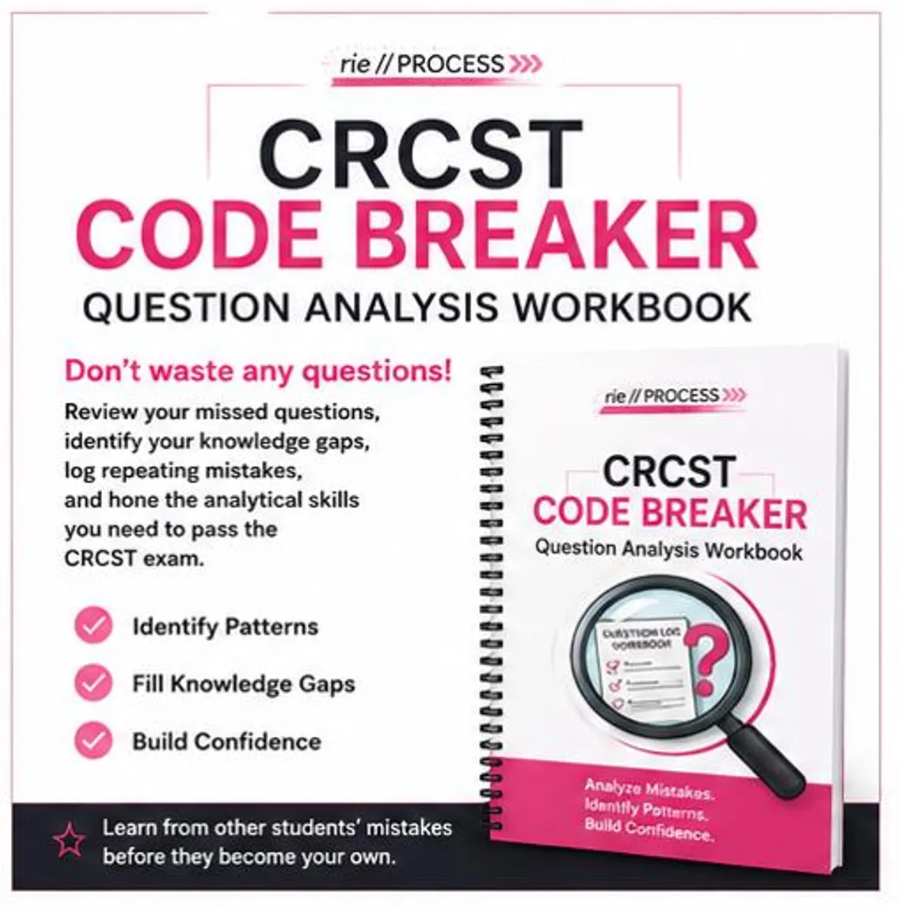
Move beyond individual tips with guided question analysis, decision-making practice, and strategies you can apply throughout your certification prep.
A guided CRCST study workbook that helps candidates analyze missed questions, identify patterns, and turn practice test mistakes into targeted study opportunities.
CERTIFICATION PREP