LEARN SPD · INSPECTION + ASSEMBLY
CLEAN ISN’T THE FINISH LINE.
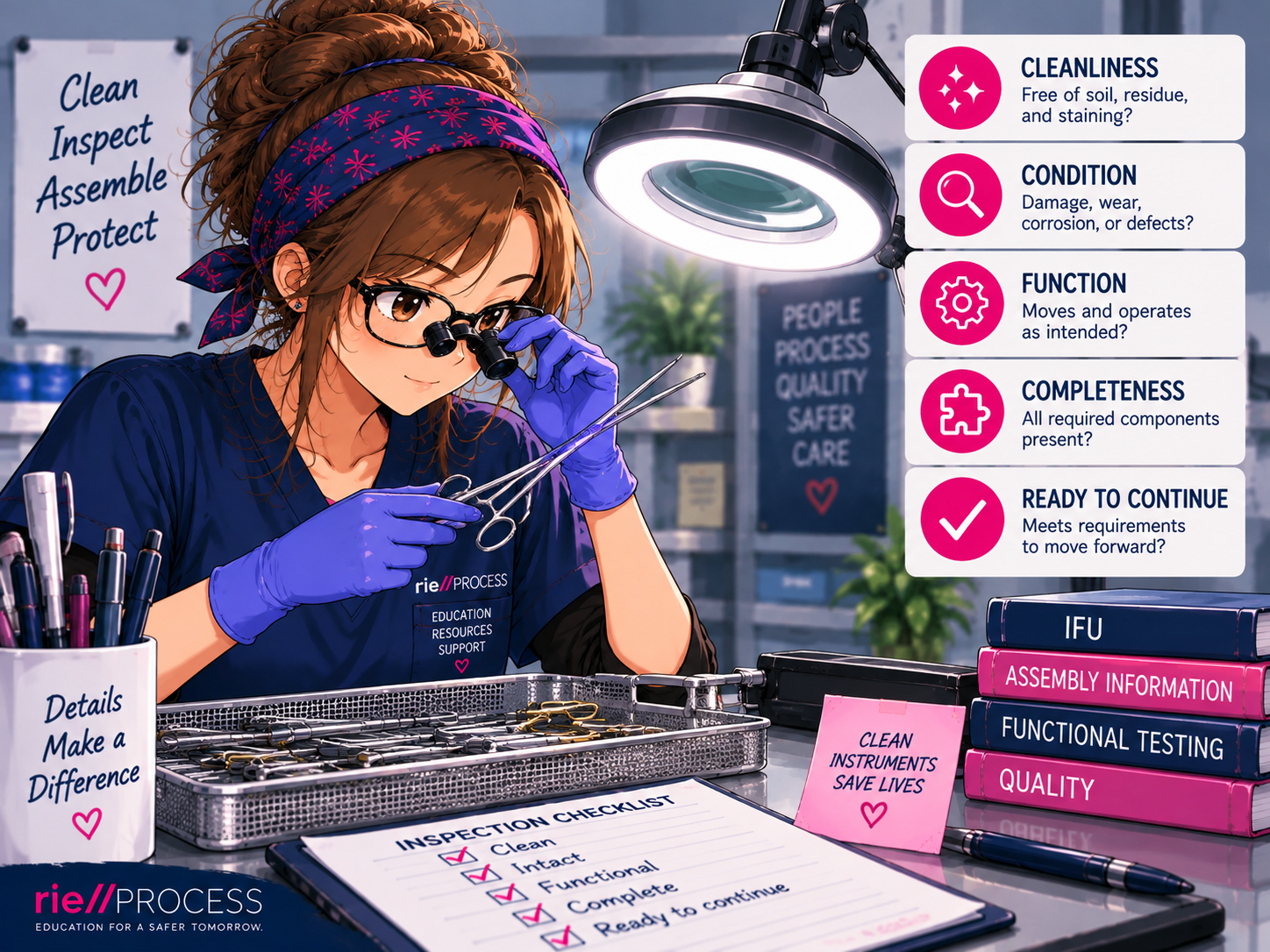
Cleaning prepares an instrument for inspection. Inspection determines whether than instrument is clean, intact, functional, complete, and ready to continue through the process.
A device can be free of visible soil and still be damaged, defective, incomplete, or unsuitable for use.
FROM CLEANING TO INSPECTION
Cleaning answers one question. Inspection answers several more.
Successful cleaning is essential - but cleanliness alone does not establish that an instrument is ready for assembly, packaging, sterilization, or eventual use.
Once cleaning is complete, the focus shifts:
Cleaning asks:
Is the contamination gone?
Inspection asks:
Is the device acceptable to keep moving?
That means evaluating more than what is immediately visible.
The Inspection Mindset
Clean → Intact → Functional → Complete → Ready to continue
Each step adds another piece of information about whether the device should proceed.
Visual inspection
Don’t just look at it. Inspect it.
Inspection is an intentional evaluation of the device - not a quick glance before placing it in a tray.
Depending on the device and its instructions for use, inspection may include evaluating:
-
Are soil, residue, staining, or other signs of inadequate cleaning present?
-
Are there signs of damage, corrosion, cracking, pitting, wear, misalignment, or deterioration?
-
Do moving parts, hinges, ratchets, cutting surfaces, jaws, and other functional components operate as intended?
-
Are required components present, correctly positioned, and properly assembled?
-
Based on everything observed, is the device acceptable to continue through the process?
The goal isn’t to find a reason to pass the instrument. The goal is to determine whether it meets the requirements to move forward.
Visibility matters
You can’t inspect what you can’t see.
Meaningful inspection requires conditions that allow the technician to actually evaluate the device.
That may include:
-
Surfaces and components must be visible enough to evaluate.
-
Magnification can help reveal details that may be difficult to identify with unaided vision.
-
Hinged, multi-part, or complex devices may need to be opened, manipulated, or otherwise positioned so relevant surfaces can be examined.
-
Some devices contain internal channels or surfaces that cannot be adequately evaluated from the outside and may require appropriate inspection methods or equipment.
-
The manufacturer’s current instructions help determine how the device should be inspected and what criteria apply.
Inspection quality depends on inspection conditions.
If the technician cannot adequately see or access the area being evaluated, the inspection itself is limited.
Functional inspection
Looks Fine isn’t the same as works right.
Some defects are visible.
Others only become apparent when the instrument is operated.
Functional inspection may require checking characteristics such as:
movement
alignment
articulation
ratchet engagement
jaw approximation
cutting performance
component security
insulation integrity
other device-specific functions
The appropriate functional checks depend on the device and applicable manufacturer instructions.
Don’t assume function from appearance.
An instrument can look clean and intact while still failing to perform as intended.
Assembly
Every piece has a purpose.
Assembly brings individual instruments and components together according to the requirements of the set, procedure, and facility.
The goal is not simply to fill every space in the tray.
During assembly, the technician verifies that:
-
Instruments and components match the applicable count sheet or assembly information.
-
Missing and additional items are identified rather than quietly overlooked.
-
Multi-part devices are assembled as required for the next stage of processing and eventual use.
-
Arrangement supports protection, processing, presentation, and safe handling.
-
Missing, damaged, incorrect, or unavailable items are handled according to facility procedure.
Assembly Isn’t packing a box.
It is another verification point in the process.
Assembly Information
Use the Information. Don’t work from memory.
Count sheets, assembly instructions, manufacturer information, and facility procedures help technicians determine what belongs in a set and how it should be prepared.
Experience can make a technician faster at recognizing instruments and assembling familiar trays.
It does not eliminate the need to verify.
A familiar tray can still change.
An instrument can still be missing.
A substitute can still be incorrect.
A device can still have requirements worth checking.
Memory can support the process. It shouldn’t replace the process.
Related 5-Minute Huddle
Memory Is Not an IFU
When a requirement matters, verify it using the current applicable source rather than relying on memory or “how we’ve always done it.”
The decision point
During inspection or assembly, you may find:
SOIL.
DAMAGE.
A FUNCTIONAL DEFECT.
A MISSING COMPONENT.
THE WRONG INSTRUMENT.
AN UNRESOLVED QUESTION.
The correct response is not to keep the instrument moving simply because the tray needs to be finished.
STOP THE PROCESS.
Prevent the unacceptable device or unresolved condition from continuing forward.
Then follow the applicable manufacturer instructions and facility procedures for the situation, which may include recleaning, removing an instrument from service, obtaining a replacement, documenting a discrepancy, or escalating the concern.
Finding the problem is the process working.
Finding a problem during inspection isn’t a processing failure. allowing a known problem to continue is.
Reality check
The delay isn’t always the failure.
A technician discovers during assembly that an instrument does not function correctly.
The instrument is removed and a replacement is obtained.
The tray takes longer to complete.
From a workflow perspective, that may feel like a problem.
From a quality perspective, something important happened:
The inspection process identified the defect before the instrument reached the patient.
Speed matters in Sterile Processing.
So do productivity and turnaround.
But none of them make an unacceptable device acceptable.
The safest decision may create a temporary delay.
That doesn’t mean it was the wrong decision.
Code Breaker
What is the question really asking?
Inspection and assembly questions often include tempting answers built around speed, habit, convenience, or keeping the workflow moving.
When you’re deciding what should happen next, ask:
Is there a cleanliness concern?
Is there a safety or functional concern?
Does something need to be verified?
Would continuing allow an unresolved problem to move forward?
Then return to the priority:
Protect the process before protecting the schedule.
Take this with you
Don’t ask only:
“Is it clean?”
Ask:
“Is this device ready to keep moving?”
Cleaning prepares the device for inspection.
Inspection evaluates its condition.
Functional testing evaluates its performance.
Assembly verifies the set.
And when something isn’t right, the process stops long enough to address it.
CLEAN → INSPECT → VERIFY → ASSEMBLE → CONTINUE
Keep Learning
Turn the concept into a conversation.
The 5-Minute Huddle 001
The Instrument Is Clean. Now What?
Use this free team huddle to explore why cleaning isn’t the finish line and what should happen when a clean instrument doesn’t meet inspection expectations.
Continue the instrument journey
Inspection doesn’t end the process.
Once instruments have been inspected, verified, and correctly assembled, the next step is preparing them for the processing method that follows.
Free educational content from rie//PROCESS.